Just consider being able to pay for your chai or metro without having to reach for your phone—all you need to do is look at a QR code and say “Pay.”
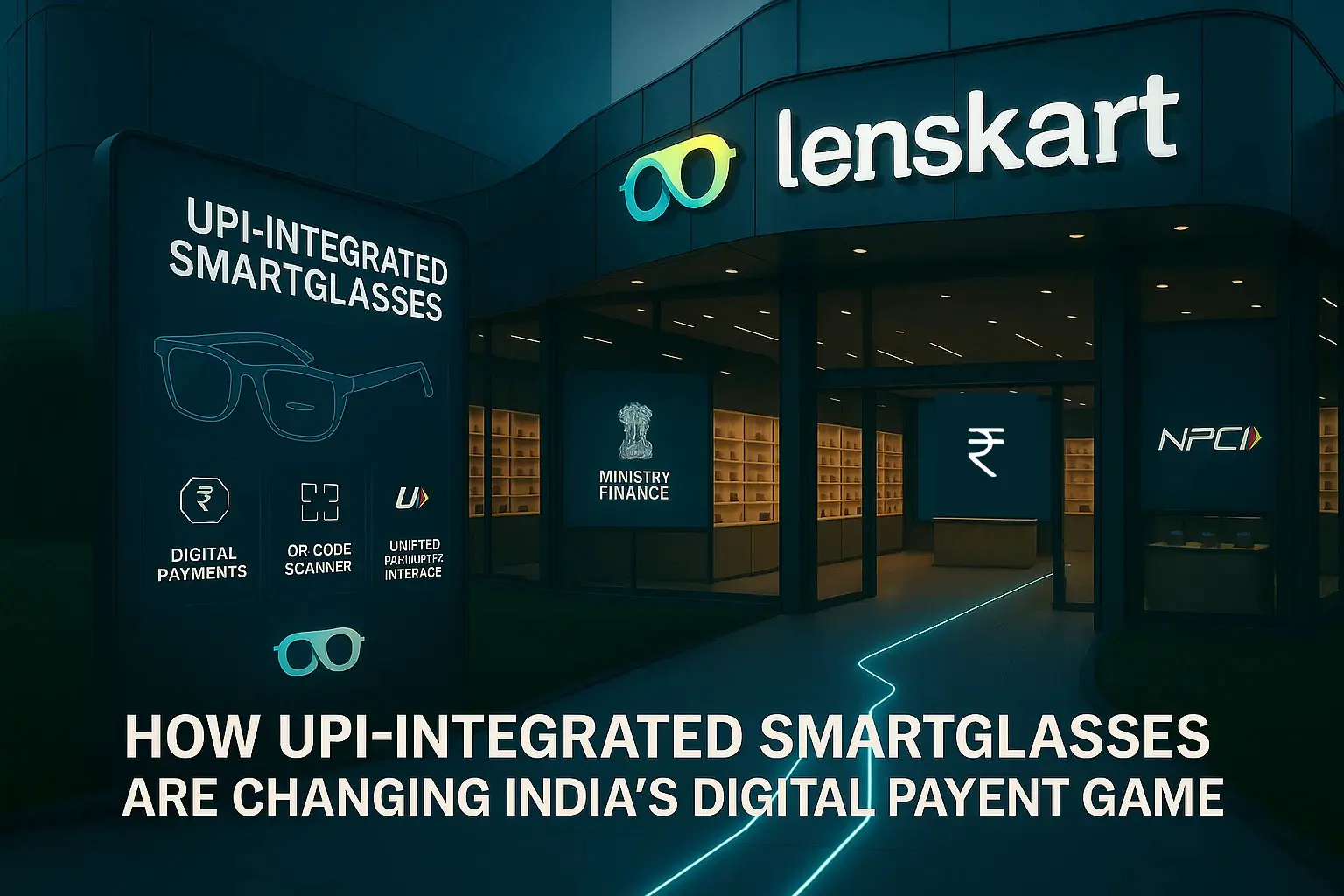
Lenskart, guided by Peyush Bansal, has introduced India’s first UPI-integrated smartglasses at the Global Fintech Festival 2025.
These B Camera Smartglasses come with a built-in camera, voice authentication, and UPI Lite for fast, secure payments—no phone, no PIN, just pure convenience.
By combining eyewear with fintech, Lenskart is redefining how India interacts with digital payments, retail, and wearable technology—one glance at a time.
What is UPI, and Why Does It Matter?
India’s Unified Payments Interface (UPI), created by the National Payments Corporation of India (NPCI), has transformed the way Indians make payments and transfer money.
Since its launch in 2016, UPI has become the backbone of India’s cashless economy, facilitating over 20 billion transactions totaling ₹24.85 lakh crore by August 2025.
From tea stalls to metro stations, it currently represents 85% of India’s digital payments—making it one of the leading fintech systems worldwide.
With this broad reach, Lenskart, under the guidance of Peyush Bansal, is innovating UPI-integrated smartglasses.
Table of Contents
Lenskart Introduces India’s First UPI-Integrated Smartglasses
Introduced at the Global Fintech Festival 2025, Lenskart’s UPI-integrated smartglasses merge fintech, artificial intelligence, and fashion into a groundbreaking device. These smartglasses enable users to scan the UPI QR code of any merchant with the integrated camera and facilitate immediate voice-activated payments—eliminating the need for a smartphone or PIN.
Key features include:
- Direct UPI integration utilizing the new UPI Circle protocol from NPCI
- Voice authentication allowing for payments without hands-on interaction
- UPI Lite functionality for transactions of low value that do not require a PIN
- POV camera equipped for taking photos, recording videos, and performing QR code scans
- AI-based assistant that analyzes payment details and confirms transaction success
This innovation turns eyewear into a financial tool — enabling users to “look, speak, and pay.
How UPI on Smartglasses Works
- Your smartglasses with UPI integration connect safely to your bank account via UPI Circle, forming a secure and tokenized link.
- When you look at a merchant’s QR code, the integrated camera quickly recognizes it. The device then announces the amount due and awaits your straightforward voice command — either “Pay” or “Yes.”
- Your voice or biometric input serves as the UPI authentication, and in just a few seconds, the payment is processed immediately. A gentle audio signal or visual confirmation informs you that the transaction is complete.
Why UPI-Integrated Smartglasses Matter
Smart glasses that incorporate UPI represent a major breakthrough in the evolution of digital payments, merging innovation, security, and user convenience. They simplify daily transactions by providing a truly hands-free experience.
Why it matters:
- Frictionless payments—just look, say, and pay.
- Secure by design—tokenized link with voice or biometric authentication.
- Versatile use—ideal for shopping, commuting, or outdoor activities.
- Strengthens UPI’s legacy as India’s most trusted fintech innovation.
Advantages & Disadvantages of UPI-integrated Smartglasses
In this examination, we look at the advantages and disadvantages of UPI-integrated smartglasses. These wearables are reshaping daily transactions, allowing for fast, effortless, and hands-free payments.
However, it is crucial for both customers and businesses to consider the security risks, financial implications, and challenges related to their adoption.
Advantages of UPI-Integrated Smartglasses
- Makes hands-free, instant payments possible without a smartphone.
- Offers secure transactions through voice or biometric methods of authentication.
- Combines fintech with fashion, creating a user experience that is both smart and stylish.
- Supports the global expansion of UPI, opening doors to new cross-border opportunities.
- Establishes India as a forerunner in wearable fintech innovation.
Disadvantages of UPI-Integrated Smartglasses
- High manufacturing costs could restrict affordability.
- Battery life limitations could influence everyday usability.
- Merchant compatibility continues to rely on UPI adoption levels.
- Users must adapt to new payment gestures or voice commands.
- Utilizing biometrics raises concerns regarding privacy and data security.
Technology Powering the UPI-Integrated Smartglasses
- UPI Lite: Preload small amounts for quick, offline-friendly, PIN-free microtransactions (ideal for expenditures of ₹20 to ₹500).
- UPI Multi-Signatory: Allows for the secure use of wearables in shared or joint accounts.
- Voice & Biometric Security: NPCI’s updated frameworks ensure that every payment is “safe, private, and verified instantly.”
- AI Integration: On-device AI processes payment information, ensuring openness and ease for the user.
UPI-Integrated Smartglasses Benefits
- Speed & Simplicity: “Look, speak, ”pay”—payments in seconds.
- Hygienic & Contactless: No touching phones or cash.
- Secure: Voice or biometric authentication replaces PIN entry.
- Accessibility: Easier for visually impaired or elderly users.
- Universal Use: Works anywhere a UPI QR code exists—metro, café, canteen, or street vendor.
Challenges Ahead for UPI-Integrated Smartglasses
- Security Risks: Voice spoofing or device theft; needs strong biometric layers.
- Cost Factor: Advanced wearables may start at premium pricing.
- Adoption Curve: Consumers must trust wearables for payments.
- Battery Life & Usability: Needs long power life and sleek design.
- Regulation: Must stay compliant with NPCI and RBI data privacy norms.
Market Impact and Investment Angle
With the release process of UPI-integrated smartglasses, Lenskart expands its innovation beyond eyewear to include fintech. Wearable payments may propel India’s next fintech boom as UPI expands into foreign markets equivalent to Singapore and the United Arab Emirates. Investors see this as a daring move away from retail margins and toward wearable fintech growth, which is consistent with Lenskart’s ascent to a $10 billion market cap and international expansion.
The Bigger Picture of UPI-Integrated Smartglasses
The UPI-Integrated Smartglasses are not just a device—they embody India’s movement towards ambient finance: payments that take place smoothly, invisibly, and immediately.
This advancement serves everyone from students and commuters to entrepreneurs and investors, illustrating how India’s fintech sector is democratizing ease and reshaping user experience.
As Peyush Bansal stated (per industry reports), “The future of eyewear isn’t merely about vision—it’s about intelligence and interaction.”
With UPI now literally in sight, that future could be closer than we think.
Lenskart UPI-Integrated Smartglasses: Wearable Payments FAQS
What are UPI-Integrated Smartglasses?
UPI-Integrated Smartglasses are wearable eyewear that let users scan QR codes and make UPI payments directly using voice or biometrics—no phone or PIN required.
What is UPI and why is it important?
UPI (Unified Payments Interface) is India’s instant payment network developed by NPCI. It enables real-time bank transfers and now powers over 85% of India’s digital payments.
Who developed these smartglasses?
The Lenskart B Camera Smartglasses are created by Lenskart, founded by Peyush Bansal, in collaboration with NPCI and Indian deep-tech startup Ajna Lens.
How do UPI payments on smartglasses work?
You look at a QR code, the glasses scan it, and you confirm payment by saying “Pay.” The glasses send the request via UPI Circle—all hands-free.
What is UPI Lite and how does it help?
UPI Lite allows small, quick transactions (₹20–₹500) without needing a PIN or network connection—ideal for wearables and micro-payments.
Are voice payments secure?
Yes. Each transaction is verified in real time by NPCI and banks, using voice or biometric data. Devices are tokenized to prevent misuse.
When will Lenskart’s UPI smartglasses launch?
They are set to be launched in late 2025 or early 2026.
Information regarding pricing and variants (Basic and AI Pro models) will be shared closer to the launch.
Why does this matter for India’s digital economy?
Because it moves UPI from phones to wearables — expanding convenience, financial inclusion, and consumer adoption in India’s fintech ecosystem.
Final Takeaway
Lenskart’s introduction of UPI-integrated smartglasses represents a crucial milestone for India’s fintech landscape.
By combining UPI, AI, and wearable technology, Lenskart is not merely retailing eyewear—it is redefining how India will visualize, reason, and conduct payments moving forward.
With India at the forefront of digital payments, these glasses could emerge as the next icon of a completely cashless, hands-free future.