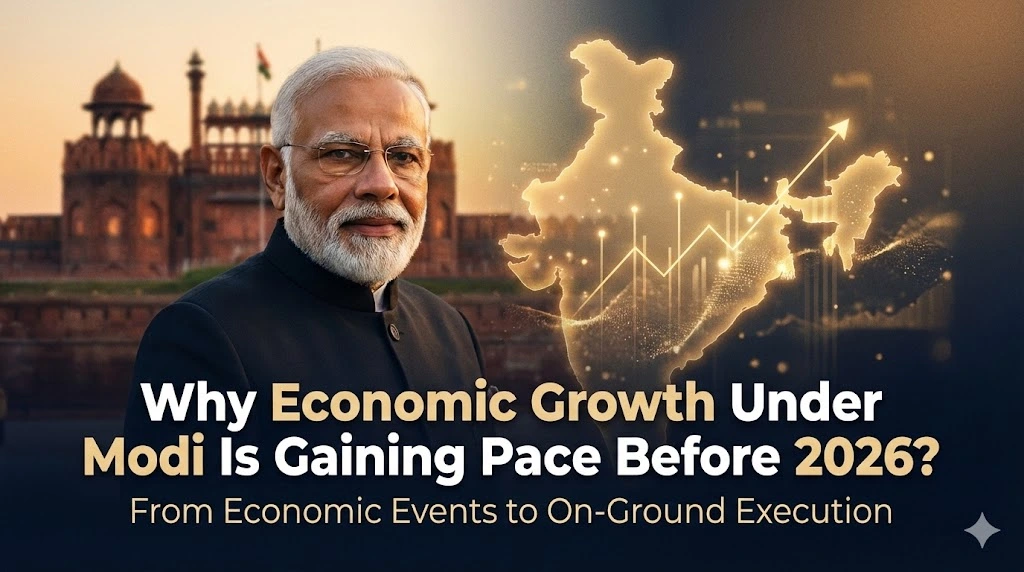
India’s economic growth vision for 2026 has evolved beyond speeches and policy documents. Under Narendra Modi’s leadership, it is being implemented through continuous economic events, investor summits, global discussions, trade fairs, and technology conferences across various states and regions.
This event-driven approach is turning policy goals into real investments, job opportunities, manufacturing capacity, and international partnerships, speeding up India’s progress toward a $5 trillion economy.
Current Position of the Indian Economy
In 2024–25, India is recognized as one of the strongest economic growth narratives globally:
- Nominal GDP: ~$3.7 trillion
- Global Rank: 5th largest economy
- Growth Status: Fastest-growing major economy in the G20
- Target: $5 trillion economy by 2026–27
- Long-term Vision: Viksit Bharat 2047
The growth is propelled by strong domestic demand, public infrastructure expenditure, growing manufacturing, and quick business formalization.
Table of Contents
What Is the Indian Economy?
India has a mixed economic growth model that combines both public and private sectors working in unison.
Key Sectors
- Primary: Agriculture, mining
- Secondary: Manufacturing, industrial production
- Tertiary: Services—IT, banking, logistics, tourism, education
- Four Growth Pillars
- Agriculture & rural economy
- Manufacturing & MSMEs
- Services sector
- Infrastructure & capital investment
A balanced development across these pillars provides India with long-term economic stability.
Modi’s Business Vision 2026: Core Growth Model
Modi’s Business Vision 2026 is more than just a policy announcement or a single roadmap. It represents an ongoing economic growth model focused on execution, adapting through regular economic events, reforms, and practical implementation in various states. The goal is to transition from policy intentions to tangible results like investment inflows, job creation, increased productivity, and enhanced global competitiveness.
This vision is built on five closely linked pillars, where advancements in one area bolster the others, forming a self-sustaining growth cycle:
- Manufacturing-led growth (Make in India)
- MSME expansion through easier credit & compliance
- Startup-driven innovation
- Infrastructure as the growth backbone
- Technology & AI for productivity and governance
All these pillars are bolstered by regional and national economic events, investor summits, trade fairs, and global partnerships. This ensures that Modi’s Business Vision 2026 is not only a theoretical strategy but is also being actively carried out across various states and sectors.
Manufacturing: Engine of the $5 Trillion Economy
Manufacturing is at the heart of India’s growth strategy, indicating a shift from dependence on imports to local production and exports.
Regional Investment-Led Manufacturing
The focus is shifting from just metropolitan areas to regional development through investment summits and industrial forums.
Vibrant Gujarat Regional Conference (Saurashtra & Kutch)
Conducted in Rajkot, it emphasized:
- Manufacturing in renewable energy
- Industrial clusters based on MSMEs
- Development centered around ports.
- Logistics and export services
This demonstrates the integration of regional capabilities into global supply chains.
High-Growth Manufacturing Sectors
- Electronics and mobile phones
- Manufacturing of electric vehicles and batteries
- Automotive and related industries
- Defense and aerospace sectors
- Drones and IT hardware (such as laptops)
These industries are essential for job creation, export growth, and tax revenue, which are critical for reaching the $5 trillion goal.
MSMEs: Backbone of Inclusive Growth
MSMEs are the backbone of India’s economy:
- ~30% of GDP
- ~45% of exports
- Jobs for over 11 crore people
MSME Credit & Formalisation Initiative
Events across India promote:
- Udyam registration
- Collateral-free MSME loans
- Interest subsidies
- Quicker grievance resolution
The Gwalior Trade Fair 2026 clearly shows this effect. With a 50% discount on road tax for vehicles, it has increased automobile sales, logistics activities, and local jobs—directly boosting the regional economy.
Startup India: Innovation Beyond Metros
India is now recognized as the third-largest startup ecosystem in the world, with expansion into Tier-2 and Tier-3 cities.
Madhya Pradesh Startup Summit 2026 (Bhopal)
Focused on:
- Manufacturing startups
- Agritech & fintech
- Job-creating enterprises
National Startup Day, along with Startup Mahakumbh, provides lasting policy confidence, funding opportunities, and easier compliance—converting ideas into scalable businesses.
Infrastructure: Growth Multiplier
Investment in infrastructure is the most prominent part of India’s growth strategy:
- Highways and expressways
- Railways and freight corridors
- Ports and coastal facilities
- Airports and regional links
Investor summits are increasingly matching factory sites with infrastructure availability, lowering expenses and enhancing competitiveness. Spending on infrastructure also generates significant multiplier effects in steel, cement, logistics, and services.
Artificial Intelligence & Future Technology
Technology is now a core economic driver, not just a support tool.
India AI Working Group Meeting—Lucknow
Focused on AI for:
- Economic productivity
- Agriculture & healthcare
- Governance and data-driven decision-making
India AI Impact Summit 2026—New Delhi
India AI Impact Summit 2026—New Delhi aims to attract global AI investments, research partnerships, and startups—positioning India as a responsible AI innovation hub.
Global Partnerships & Foreign Investment
The economic growth strategy in India is strongly associated with international trust and collaboration.
India–Germany Inter-Governmental Consultations (January 2026)
Focusing on:
- Renewable energy
- Advanced manufacturing
- Technology transfer efforts
- Skill development initiatives
The National Conference on Strategic Trade Controls (NCSTC) has strengthened India’s position in high-tech exports, compliance, and secure global trade.
How Economic Events Are Accelerating Growth Nationwide
From Gujarat to Madhya Pradesh, and Uttar Pradesh to Delhi, economic events serve as catalysts for growth. They assist:
- States in attracting capital
- MSMEs in accessing markets
- Startups in obtaining funding
- Global companies are selecting India as a long-term base.
This guarantees that growth is spread out, rather than being focused in just a few cities.
Key Takeaways
- Manufacturing and MSMEs provide long-term, policy-supported opportunities.
- Regional events hold equal importance to national policies.
- AI and data skills are increasingly vital.
Frequently Asked Questions (FAQs) About Economic Growth Of India
What is Modi’s Business Vision 2026?
Modi’s Business Vision 2026 outlines a practical strategy for economic growth under Narendra Modi’s leadership. It aims to accelerate India’s journey to a $5 trillion economy by focusing on manufacturing, MSMEs, startups, improving infrastructure, using technology, and forming global partnerships—implemented through tangible economic actions and reforms, rather than just policy announcements.
What is the current position of the Indian economy in 2024–25?
In 2024–25, India stands as the 5th largest economy on the planet, with a nominal GDP nearing $3.7 trillion. It is recognized as one of the fastest-growing major economies internationally, backed by solid domestic demand, infrastructure spending, increasing manufacturing output, and rapid business formalization.
Which sectors are driving India’s growth under Vision 2026?
The main factors for growth include manufacturing (electronics, electric vehicles, defense, cars), MSMEs, startups, infrastructure (roads, railways, ports, airports), and tech areas like artificial intelligence and data analytics. These sectors work together to generate jobs, increase exports, and enhance productivity.
How do MSMEs and startups fit into India’s 2026 growth plan?
MSMEs are the foundation of jobs and exports, and startups are the engines of innovation and future employment. Better credit access, digital registration, simplified compliance, funding resources, and regional startup events are helping both MSMEs and startups expand beyond city limits and connect with national and global supply chains.
How will global partnerships and AI shape India’s economy by 2026?
Global collaborations are bringing in quality foreign investments, advanced technology, and export opportunities to India. At the same time, AI and digital public infrastructure are boosting efficiency in manufacturing, services, agriculture, and governance. Together, they aim to make India a trusted global hub for manufacturing and technology by 2026.
Why India’s Growth Story Now Goes Beyond Policy Announcements
India’s economic strategy for 2026 shows that growth is no longer limited to policy announcements or budget speeches.
Under Narendra Modi’s leadership, practical execution—through manufacturing drives, MSME support, startup platforms, infrastructure expansion, technology adoption, and global partnerships—is converting vision into tangible outcomes across regions, not just in major cities.
As India approaches the $5 trillion economy goal, the real opportunity lies in early alignment with these growth engines. For businesses, professionals, and students, success will rely on skills, sector choices, and regional participation in this ongoing change, which is already reshaping India’s economic future beyond 2026.