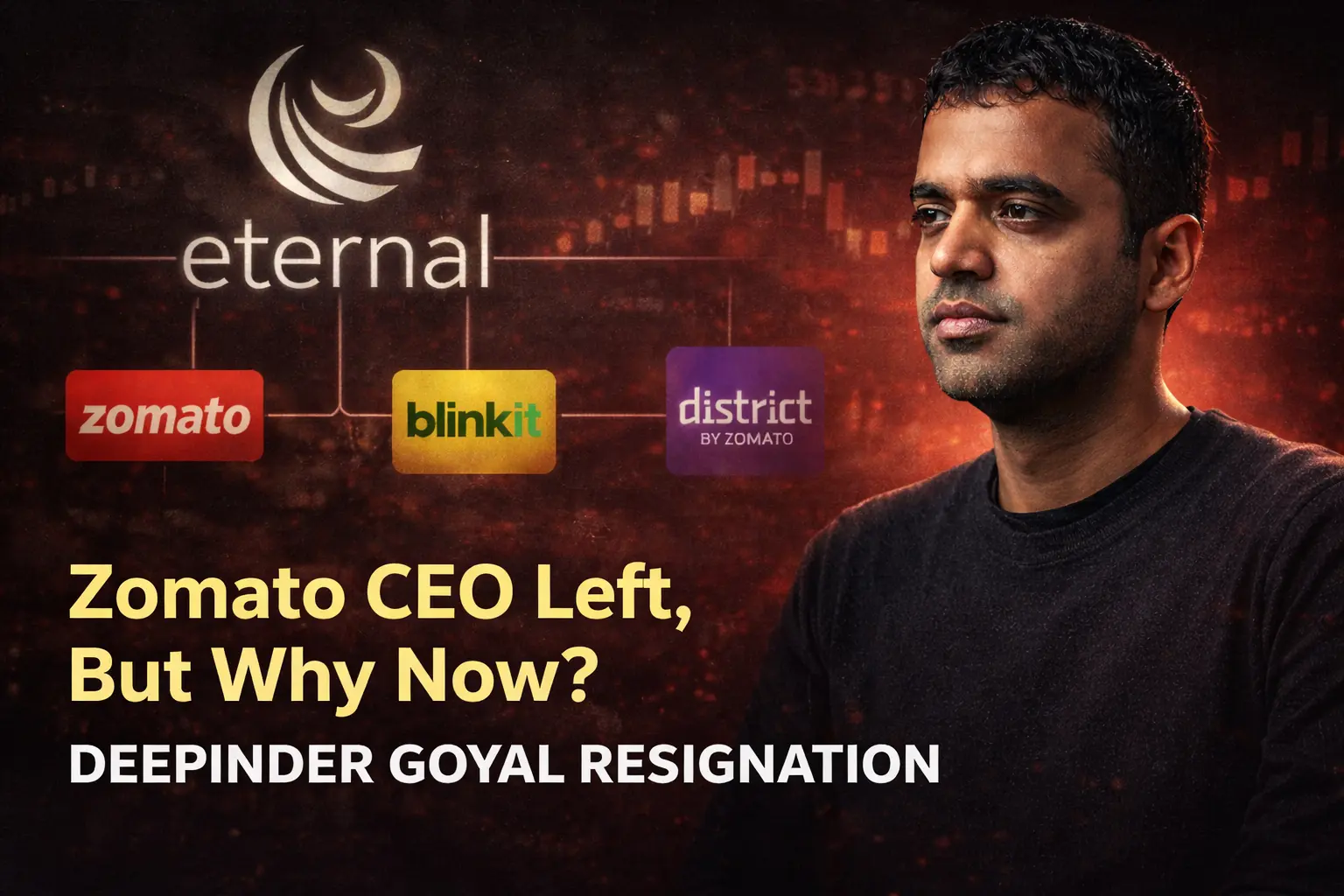
The Deepinder Goyal resignation from his role as Group CEO and Managing Director of Eternal Limited is not simply another leadership change—it signifies a crucial turning point in the consumer-tech sector of India. When the Zomato founder announced his resignation in January 2026, it caught many off guard. Eternal had just reported one of its best quarters, with a consolidated net profit of ₹102 crore, a 73% increase from the previous year, and Blinkit achieving EBITDA positivity for the first time.
This departure was not a result of pressure or a reaction. It was a thoughtful, strategic decision, symbolizing a company ready to enter its next institutional phase.
Deepinder Goyal Resignation: Zomato Founder Steps Back
Differing from many startup founders who step back during slow periods or crises, Deepinder Goyal moved away from daily oversight when Eternal was financially stable. He explained that managing a public company requires predictability and continuous execution, which conflicted with his growing fascination with high-risk experimentation.
While markets tend to reward stable growth, Goyal was increasingly attracted to uncertain “zero-to-one” ventures such as longevity, deep tech, and aerospace. By stepping down, the Zomato founder protected Eternal from speculative risks while freeing himself to pursue innovative frontiers.
Table of Contents
Eternal CEO Resignation as Strategic “Unbundling”
The resignation of the Eternal CEO should be viewed as a strategic separation of roles, rather than a withdrawal. Eternal Limited remains a focused, execution-oriented public company. Deepinder Goyal is moving to the role of Vice Chairman, where he will concentrate on long-term vision, culture, governance, and mentoring leadership. High-risk innovation will be handled outside of Eternal, with funding provided personally by Goyal. This division creates clarity for investors, employees, and the board.
Blinkit CEO Albinder Dhindsa Takes Charge: The Operator Era Begins
The appointment of Albinder Dhindsa, founder and CEO of Blinkit, as Group CEO signals where Eternal’s future lies. Blinkit has evolved from a cash-burning acquisition into the group’s fastest-growing and largest revenue contributor.
Quick commerce is no longer an experiment—it is Eternal’s growth engine.Dhindsa represents a different leadership archetype from Goyal:
- Process-driven
- Logistics-focused
- Margin-oriented
His success in turning Blinkit EBITDA positive made him the natural choice to lead Eternal into its operational excellence phase.
Financial Strength Behind the Deepinder Goyal Resignation at Eternal
The resignation of Deepinder Goyal was backed by solid financial fundamentals, which made the leadership change easier and more reassuring for investors.
Eternal entered this stage from a strong position, not one of uncertainty, allowing Blinkit CEO Albinder Dhindsa to take over with existing momentum.
- Eternal saw a 73% increase in net profit year-on-year, showing better unit economics.
- Blinkit became EBITDA positive, validating the execution-focused strategy of Albinder Dhindsa.
- Core food delivery remained a reliable source of cash flow.
- A significant cash reserve allowed for growth investments without quick dilution.
This financial safety net ensured that the leadership transition was perceived as a strategic change rather than a risk, increasing market trust in Eternal’s long-term vision.
Governance Maturity and ESOP Signal
To strengthen Eternal’s institutional maturity, Deepinder Goyal returned his unvested ESOPs to the company pool, which sent a strong governance signal to both investors and employees. This action highlighted that his exit from daily operations was not a sign of reduced commitment but rather a change in his role and responsibilities.
- It prevents shareholder dilution, thus safeguarding long-term investor value.
- It creates a larger incentive pool for future leaders and key executives.
- It shows ongoing alignment with Eternal’s long-term growth, even after stepping down.
For a founder frequently viewed as aggressive and uncompromising in execution, this decision was remarkable as a rare and meaningful act of governance discipline and institutional thinking.
The District App: First Big Test of the Post-Goyal Era
While Blinkit focuses on profitability, Eternal’s vision is broader. The District app, which targets movie tickets, events, and dining experiences, is Eternal’s initiative to take on BookMyShow and lead the ‘going-out economy.’
Initial traction is significant—millions of downloads and a ₹10,000 crore annualized GOV—but user complaints about refunds and customer service reveal execution issues.
How Dhindsa balances logistics efficiency with experience-centric businesses like District will be the initial true test for Eternal after the Zomato founder’s exit as CEO.
What Deepinder Goyal Is Doing Next
After his resignation, Deepinder Goyal is now dedicating his efforts to high-risk deep-tech projects beyond Eternal, including longevity studies at his personal lab. He continues to work on brain-monitoring wearables and LAT Aerospace, which aims to develop cost-effective regional aircraft. These initiatives involve long timelines and uncertain results—precisely the kind of experimentation that is better suited for a private organization.
Market View on Eternal: Relief, Not Fear After CEO Transition
The market’s reaction to the transition of the Eternal CEO has been mostly reassuring. Analysts assert that this move enhances governance instead of diminishing the business, as Eternal is now guided by a capable successor, has a strong balance sheet, and operates with clearly defined verticals.The firm is increasingly acknowledged as a mature internet conglomerate, no longer dependent on its founder for routine operations.
However, there are still challenges that are external rather than related to leadership:
- Regulations that affect gig workers, which could have an impact on delivery economics
- Strong competition in quick commerce, especially in terms of pricing and margins
- The quality of execution in new areas, including the ability to scale beyond core businesses
Significantly, the leadership transition is no longer perceived as a risk factor, showcasing a rising confidence in Eternal’s institutional capabilities.
Frequently Asked Questions (FAQs) About Deepinder Goyal Resignation
Why did Deepinder Goyal quit as CEO?
Deepinder Goyal stepped down on his own initiative to shift his focus towards high-risk, experimental ideas that are difficult to chase while operating a publicly listed company. He noted that the position of a public company CEO demands a degree of predictability and relentless execution, which conflicted with his increasing fascination with deep-tech innovation.
Did the CEO of Zomato resign?
Yes, Deepinder Goyal has resigned from his role as Group CEO and Managing Director of Eternal Limited, the parent company of Zomato. However, he continues to be part of the company as vice chairman, where he will focus on long-term strategy and governance.
How much of Eternal (Zomato) is owned by Deepinder Goyal?
Deepinder Goyal has a minority ownership of about 4–5% in Eternal Limited. Even though he is not the CEO anymore, his financial interests are still aligned with the company’s long-term performance.
Is Blinkit 100% owned by Zomato (Eternal)?
Yes, Blinkit is entirely owned by Eternal Limited, which also controls Zomato and several other sectors. Blinkit operates on its own but is fully reflected in Eternal’s financial documents.
Why was Deepinder Goyal removed from Shark Tank India?
Deepinder Goyal’s exit from Shark Tank India came after reports indicated a conflict of interest, as the show was funded by Swiggy, a competitor of Zomato. There was no official scandal, and his departure was interpreted as a strategic choice.
Deepinder Goyal Exit Signals Eternal’s Shift to Institution Building
The resignation of Deepinder Goyal is not merely about stepping down; it is more about stepping aside—allowing the company to grow steadily while giving the founder the freedom to innovate. For Eternal, this marks a transition from a founder-led vision to one led by institutional execution. This sets a new benchmark for Indian startups: founders do not need to hold onto the CEO chair indefinitely to create a lasting legacy.
Although the captain has changed, the ship is now financially stronger, strategically clearer, and firmly on its course.