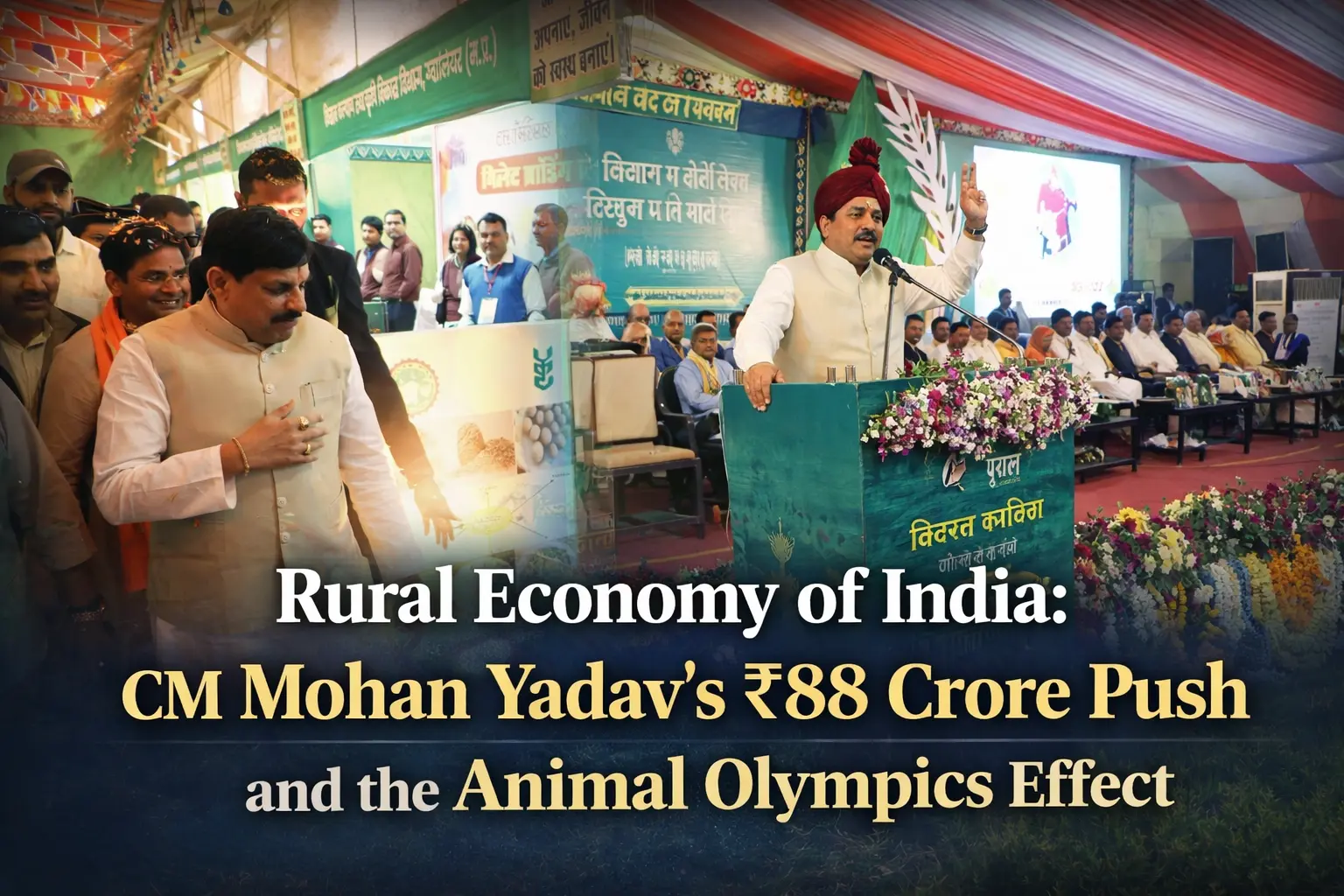
The Kuleth Kheda Kisan Fair honors Shri Maharaj Singh Yadav (Bapu Ji) and is currently overseen by Shivraj Yadav, a member of the Jila Panchayat. It has transformed from a family event into a crucial contributor to the rural economy of India. In 2026, the fair saw an unprecedented level of participation, indicating a rise in rural engagement and policy alignment.
On February 18, 2026, the event was upgraded to a state-level occasion under Krishak Kalyan Varsh 2026 (Farmer Welfare Year), with Dr. Mohan Yadav, the Chief Minister of Madhya Pradesh, as the Chief Guest. During the event, the government announced and initiated 41 development projects worth ₹87.86 crore.
This financial boost allowed the fair to evolve from a memorial event into a structured tool for enhancing India’s rural economy, promoting infrastructure investment, agricultural modernization, and local trade growth in the Gwalior–Chambal area.
Rural Economy of India: ₹88 Crore Targeted Stimulus
The allocation of ₹87.86 crore is not just a symbolic gesture; it represents a deliberate investment aimed at strengthening India’s rural economy. The funds will be used to improve rural roads, irrigation systems, storage facilities, and market infrastructure in and around Gwalior. This kind of capital expenditure in farming communities is crucial for enhancing productivity and usually results in a strong multiplier effect throughout the rural economy of India, stimulating local employment, trade, and income growth.
When the state allocates ₹88 crore to a rural ecosystem:
- Contractors engage local labor.
- Construction materials are obtained from local suppliers.
- Daily wages are spent in grocery stores, transport services, and various service providers.
- Farm logistics are enhanced, which helps to minimize post-harvest losses.
With a high marginal propensity to consume in rural areas, even conservative estimates of the multiplier suggest that the ₹88 crore could produce several times that amount in economic activity over the lifespan of these projects.
This is more than just building infrastructure. It is about activating liquidity.
How Animal Olympics Strengthen the Rural Economy of India
The Kuleth Kheda Kisan Fair highlighted the traditional “Animal Olympics,” which featured horse races (घोड़ी दौड़), bullock-cart races (बैलगाड़ी दौड़), running contests, and other rural sports. These activities were not just cultural events but also acted as economic enhancers for the rural economy in India.
Horse racing and bullock-cart races support livestock breeding, animal care services, fodder supply chains, and local veterinary needs—all contributing to income for rural households. The distribution of prize money circulates cash in farming communities, which enhances local consumption.
These rural sporting traditions create temporary markets, increase foot traffic, and support small businesses, including food stalls, transport services, and local vendors. In this way, the Animal Olympics aspect of the fair reinforces how cultural events can positively impact the rural economy of India by combining heritage, participation, and local economic activity.
Table of Contents
Rural Economy of India: Infra Cuts Costs, Boosts Margins
Connectivity and irrigation are key cost factors for farmers in the Gwalior–Chambal region.
The improvement of rural roads leads to:
- A reduction in fuel consumption for trips to mandis
- A decrease in transit time for perishable crops
- Less reliance on middlemen.
Better irrigation practices diminish crop risk and enhance yield predictability.
As production costs decline and market access improves, profitability at the farm level rises. This increase in margins is crucial for Madhya Pradesh’s objective of transforming agriculture from subsistence to scalable agribusiness.
This initiative also corresponds with the state’s broader economic goal of transitioning to a $1 trillion GSDP and ultimately achieving a $2.1 trillion economy by 2047.
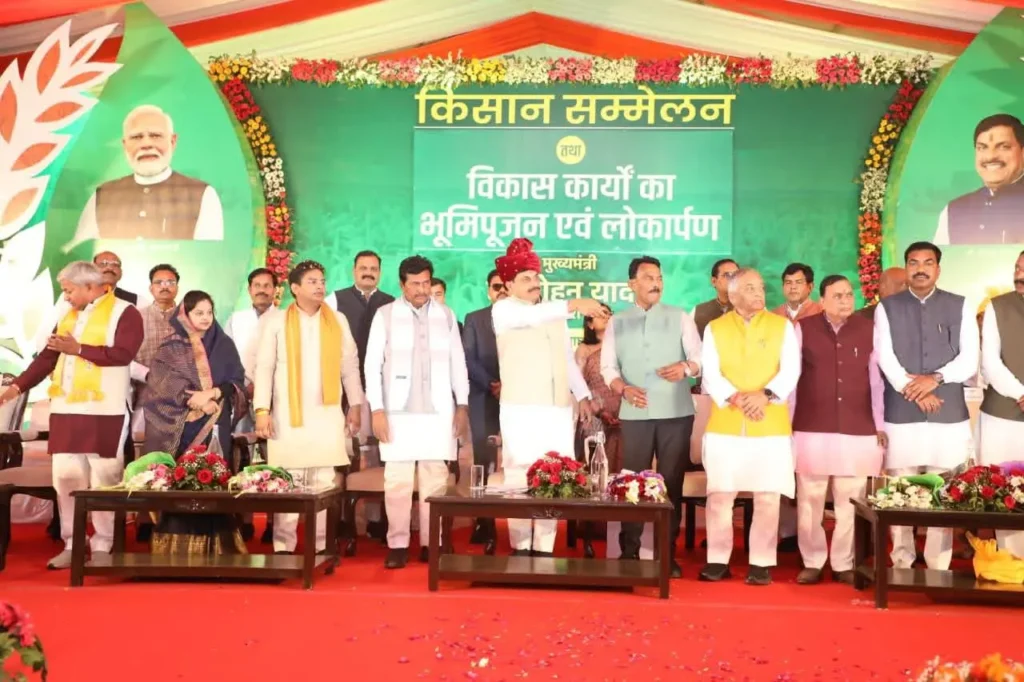
Agri-Tech Showcase: From Traditional Farming to Value Chains
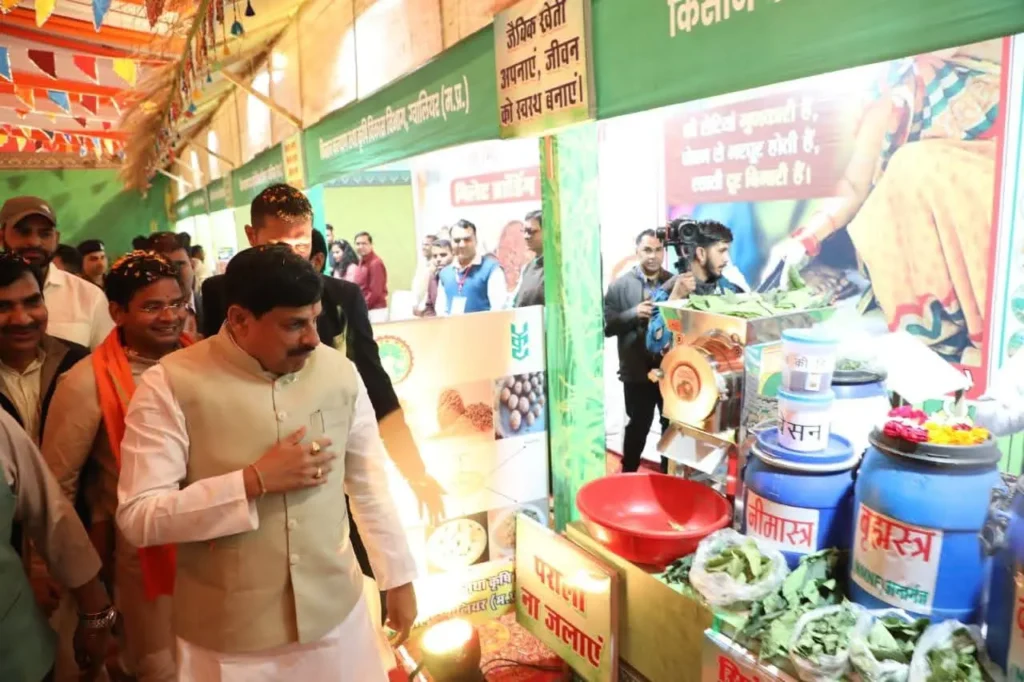
The trade fair was not just about announcements. It also featured exhibitions on:
- Horticulture
- Natural farming techniques
- Improving livestock breeds
- Farm mechanization
These platforms act as rural B2B ecosystems. Seed firms, irrigation service providers, equipment producers, and agri-startups engage directly with farmers, their ultimate consumers.
For MSMEs, this indicates acquiring customers on a large scale.
For farmers, it furnishes tools that increase productivity, boosting the yield per acre and allowing them to venture into higher-value crops.
If these connections are consistently improved, they can facilitate the transition from selling raw produce to engaging in value-added processing—crucial for generating wealth in rural communities.
Government Spending and Direct Benefit Transfers: Dual-Layer Impact
The importance of direct income support mechanisms in reinforcing the rural economy of India cannot be overstated. Transfers from farmer welfare initiatives were positioned as a fundamental aspect of the broader 2026 strategy, ensuring that liquidity reaches households while also promoting long-term development projects.
This generates a dual-layer stimulus for the rural economy of India:
- Capital expenditure (creation of long-term assets).
- Immediate cash support (increasing current consumption).
The integration of these components enhances supply-side capacity (infrastructure, irrigation, technology) and fortifies demand-side resilience (household liquidity).
From a macroeconomic angle, this framework stabilizes rural consumption—which is being increasingly acknowledged by economists as a key driver of India’s GDP growth cycle.
Rural Economy of India: Fairs Drive Micro Growth
Traditional events, including bullock-cart races and folk competitions, were integrated into the Trade Fair.
Although they seem cultural, such gatherings stimulate measurable economic activity:
- Food and beverage vendors see spikes in revenue.
- Transport services operate more frequently.
- Short-term retail stalls gather concentrated demand.
- Prize money circulates locally.
Rural fairs function as short-term demand clusters—effectively serving as micro stimulus zones. When associated with government infrastructure announcements, they create both symbolic and transactional momentum.
Why Gwalior-Chambal Matters Strategically
The Gwalior-Chambal region is currently experiencing an expansion in infrastructure and connectivity, including upgrades to highways and the establishment of industrial corridor linkages.
Enhanced connectivity leads to secondary effects:
- Appreciation in land value.
- Development of agri-processing units.
- Formation of logistics hubs.
Greater attractiveness for MSME investments.
When rural infrastructure aligns with industrial policy, agriculture stops being isolated. It becomes part of a broader production network.
The Bigger Question: Is Rural MP Entering an Investment Phase?
Proclaiming 2026 as the Year for Farmer Welfare is more than just a political statement. It combines a diverse set of schemes, infrastructure projects, and agri-tech initiatives into a unified story of growth.
If this momentum is sustained, Madhya Pradesh could see:
- Advancement of agri-MSMEs.
- Increased rural consumption.
- Advancement in farm-linked manufacturing.
- Stronger credit profiles for rural borrowers.
For investors, agri-startups, equipment makers, and rural supply-chain stakeholders, the message is clear: capital is being invested at the grassroots level.
The critical factor is the continuity of execution.
If projects are delivered on time and market linkages strengthen, the ₹88 crore injection in Kuleth Kheda may be remembered not as a singular event but as the beginning of a rural capital cycle.
In a nation where over two-thirds of livelihoods are connected to agriculture, the next growth engine may not emerge from urban centers.
It may rise from villages where infrastructure, liquidity, and technology converge.
Frequently Asked Questions About : Rural Economy
What was the main objective of the Kisan Fair 2026 in Gwalior?
The central goal was to begin and accelerate rural economic development under Krishak Kalyan Varsh 2026 by launching 41 infrastructure and agri-focused projects valued at about ₹88 crore, while creating a platform for engaging farmers, adopting technology, and integrating into the market.
What is the economic significance of the ₹87.86 crore announcement?
The ₹87.86 crore financial injection serves as a precise fiscal stimulus, creating jobs, enhancing local demand for construction materials and services, and triggering a multiplier effect that broadens overall rural economic output beyond the initial investment.
How does rural infrastructure improve farm profitability?
Improved infrastructure like roads, irrigation systems, storage facilities, and market access reduces transport costs, cuts down post-harvest losses, increases productivity, and helps farmers get better prices, which directly boosts net profit margins.
Why is Direct Benefit Transfer (DBT) important alongside infrastructure projects?
Infrastructure fosters long-term productivity, but direct benefit transfers ensure immediate cash flow by depositing money directly into farmers’ accounts, aiding them in managing their expenses and stabilizing their household finances.
How does the Trade Fair support agri-MSMEs and rural entrepreneurship?
By showcasing agri-tech solutions, machinery, and value-chain opportunities, the Trade Fair connects farmers with startups, equipment manufacturers, and processors, encouraging commercialization, value addition, and MSME growth in rural areas.
Rural Capital Cycle Begins in Gwalior as ₹88 Crore Push Signals Structural Shift
The ₹87.86 crore investment in 41 projects at Kuleth Kheda indicates a targeted effort to boost India’s rural economy through infrastructure development and direct income support.
Upgraded roads, irrigation, storage, and market access, paired with PM-Kisan transfers, will foster both long-term productivity and short-term financial liquidity.
If carried out consistently, this strategy can boost farm income, elevate rural consumption, and position the rural economy of India as a continuous driver of structural growth rather than a fleeting policy effort.