The financial burden of medical care is escalating more rapidly than salary increases—merely one hospital visit can wipe out years of accumulated savings. This underscores the importance of understanding the tax benefits of health insurance. Health insurance not only protects your health; it also shields your wealth by lowering your tax burden.
According to Section 80D of the Income Tax Act, you can claim deductions for your health insurance premiums, and with the new 0% GST policy (effective 22 September 2025), these policies are now even more accessible. Whether you are a salaried employee, freelancer, entrepreneur, or retiree, knowing how to take advantage of these health insurance tax benefits can help you save substantial amounts while securing your family’s future.
This guide clearly outlines the details—with actual ₹ examples, common errors to avoid, and a simple step-by-step plan to legally and effortlessly maximize your savings.
Why Health Insurance Tax Benefits Matter
The costs associated with medical care are escalating more rapidly than wages—a single hospital stay can erase years of financial savings. This is why it is vital to grasp the tax benefits linked to health insurance.
Health insurance serves not only to protect your health; it also shields your financial assets—by alleviating your tax obligations.
Under Section 80D of the Income Tax Act, you can receive deductions for health insurance premiums. Additionally, with the new 0% GST regulation (effective 22 September 2025), these policies are now more budget-friendly.
Whether you are a salaried individual, freelancer, entrepreneur, or retiree, being aware of how to utilize these health insurance tax benefits can assist you in saving substantial amounts while securing the future of your family.
Table of Contents
What Are Health Insurance Tax Benefits?
The tax benefits of health insurance consist of the deductions and exemptions you can claim when you pay premiums for health insurance for yourself, your family, or your parents.
In India, these benefits are specified in Section 80D of the Income Tax Act, which allows you to deduct the costs of health insurance and preventive health check-ups from your taxable income—resulting in a lower tax liability.
In simpler terms: “The government incentivizes you for ensuring your family’s health.”
These health insurance tax benefits are applicable solely under the old tax regime, not the new one established under Section 115BAC.
What Is Health Insurance and How Does It Work?
Health insurance represents a financial contract between you and an insurance provider, where you make regular premium payments, and in exchange, the insurer takes care of your medical costs. It serves as a protective barrier against unforeseen hospital expenses, safeguarding your savings.
A typical health insurance policy in India usually includes:
- Hospitalization costs
- Expenses related to pre- and post-hospitalization
- Daycare treatments
- Cashless services are available at network hospitals.
- Tax advantages of health insurance as per Section 80D
For Example:
If your insured amount is ₹5 lakh and your hospital expenses total ₹3 lakh, the insurance provider will either pay it directly (cashless) or reimburse you later, based on your policy conditions.
In conclusion, health insurance allows you to focus on healing rather than hospital costs while also providing valuable tax relief under Section 80D.
Types of Health Insurance Policy Plans in India
In India, there are health insurance plans that cater to different requirements and age ranges. The main types are listed below:
Individual Health Plan
This plan is specifically designed for one person, providing coverage for hospitalization, treatment, and medical expenses all under one premium and a single insured sum.
Family Floater Plan
Offers one shared sum insured for the entire family, making it an affordable option for couples or families with children.
Senior Citizen Plan
Specifically tailored for seniors who are 60 years and older, covering health issues related to aging, existing diseases, and higher healthcare costs.
Critical Illness Plan
Offers a one-time payment upon the diagnosis of critical illnesses like cancer, heart attack, or stroke, assisting in the management of treatment expenses.
Top-Up Plan
Improves your current health insurance by providing extra coverage after your basic sum insured has been depleted.
Group Health Plan
Regularly offered by employers, this plan supplies basic health coverage for employees and may sometimes include their dependents.
Government Schemes
Cost-effective health insurance schemes like Ayushman Bharat and PMJAY focus on providing support to the economically weaker parts of society.
Health Insurance Tax Benefits Under Section 80D—Explained Simply
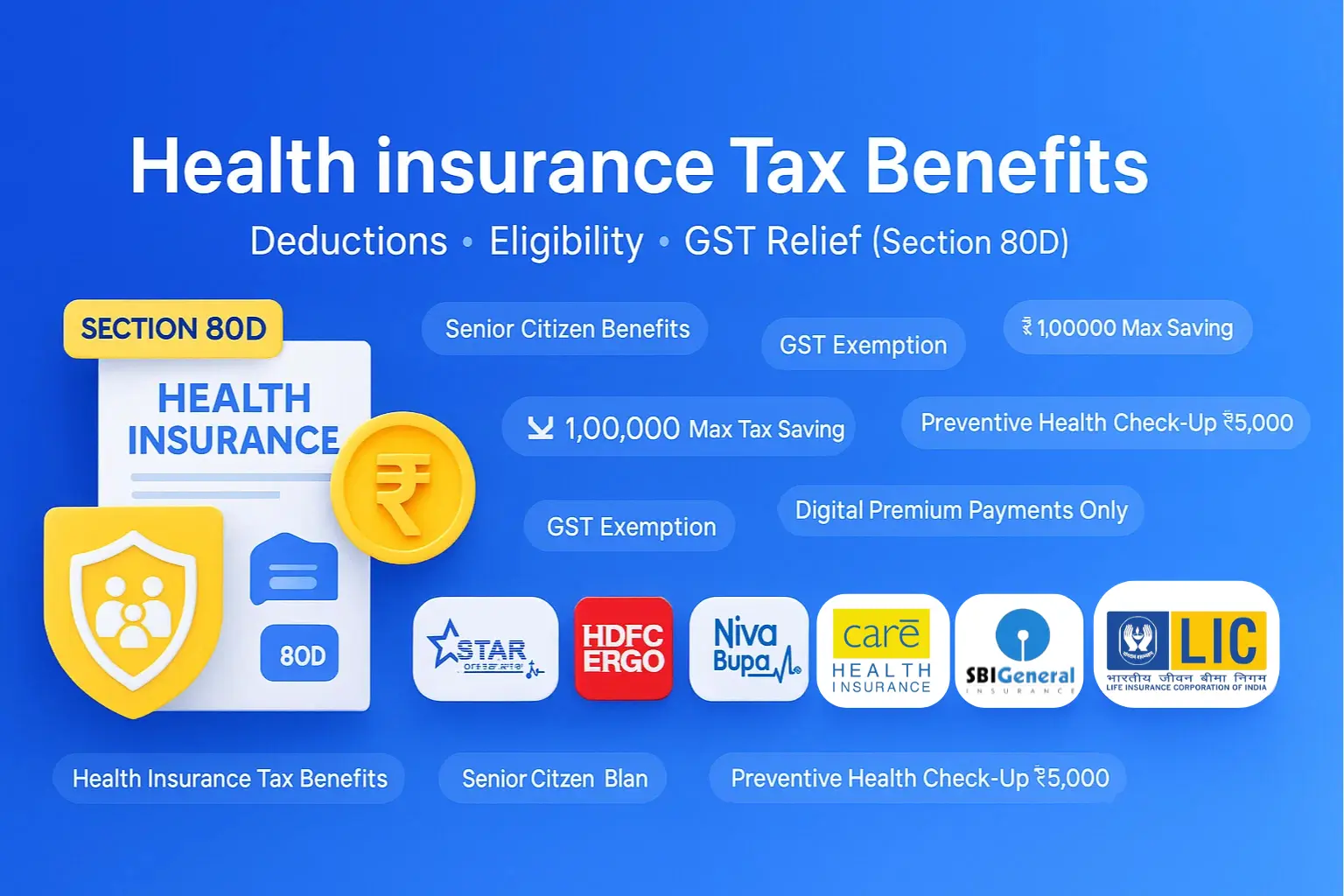
Health insurance tax benefits provided under Section 80D allow you to save on income tax for the premiums you pay for medical insurance. You can claim these benefits for policies that cover yourself, your spouse, dependent children, and parents. The deduction caps are ₹25,000 for individuals and up to ₹50,000 for senior citizens. You may also include preventive health check-ups (up to ₹5,000) within these limits. In conclusion, health insurance tax benefits not only ensure your family’s health but also help in reducing your total tax burden.
| Who’s Covered | Maximum Deduction (FY 2024–25) | Key Notes |
| Self + Spouse + Dependent Children (<60 yrs) | ₹25,000 | Family floater or individual policy |
| Parents (<60 yrs) | ₹25,000 | Separate deduction allowed |
| Parents (≥60 yrs) | ₹50,000 | Senior citizen advantage |
| Self (≥60 yrs) + Parents (≥60 yrs) | ₹1,00,000 | Combined maximum limit |
| Preventive Health Check-Up | ₹5,000 (within limit) | Can be paid in cash |
Parents are not required to be reliant—if you cover their premium, you are eligible for the deduction.
For example:
Priya (35) pays ₹18,000 for her family insurance and ₹40,000 for her 65-year-old parents.
Total claim = ₹18,000 + ₹40,000 = ₹58,000 deduction under Section 80D.
Health Insurance Tax Benefits for Senior Citizens
Individuals who are 60 years old and above, known as senior citizens, are entitled to the highest tax deduction—up to ₹50,000 under Section 80D.
If your parents are over 60 and you are responsible for their premium payments, you can claim this benefit even if they are not financially dependent on you.
For example:
Your age: 35
Parents’ age: 65
Premiums: ₹20,000 (yourself) + ₹45,000 (parents)
Total claimable amount = ₹65,000 in deductions.
In the event that your parents are uninsured, you can still claim medical expenses up to ₹50,000.
Real-Life Example: How Ramesh Saved ₹22,500 in Taxes
Ramesh, a 40-year-old IT professional, invested ₹20,000 in his own policy and ₹50,000 for his retired parents.
Under Section 80D:
- Self + Family = ₹20,000
- Parents = ₹50,000
- Total = ₹70,000 deduction
With a 30% tax rate → ₹21,000 saved + ₹1,500 for preventive check-ups = ₹22,500 total tax savings.
Common Mistakes to Avoid While Claiming 80D Deductions
- Cash payments for premiums—not allowed.
- Deductions for friends or siblings—disallowed.
- Forgetting to account for the preventive health check-up benefit (₹5,000).
- Opting for the new tax regime—80D is not applicable.
- Overlapping claims for family and individual plans.
Tip: Always use digital payments and keep receipts for ITR filing.
GST on Health Insurance Premium in India (Old vs New)
In earlier times, health insurance premiums in India were charged an 18% GST, which raised the overall policy costs. For example, a base premium of ₹10,000 would incur an additional ₹1,800 in taxes.
However, starting from 22 September 2025, the government has introduced a new GST rule that removes GST (0%) on individual and family floater health insurance policies. This important change makes health coverage 18% less expensive and encourages a greater number of people to obtain insurance.
Groups or employer-based health plans still face an 18% GST, but individual policyholders now enjoy savings through reduced premiums and health insurance tax benefits under Section 80D.
What This Indicates for You:
- Reduce your costs for the same level of coverage—or gain increased coverage for the same price (e.g., ₹10L → ₹12L).
- Pair lower premiums with health insurance tax benefits under Section 80D for double savings.
- Note: Group- or employer-provided health plans are still liable for 18% GST.
Top 10 Tax-Saving Health Insurance Tips (2025)
- Acquire early—insurance premiums are more budget-friendly.
- Use digital payment methods for tax eligibility.
- Opt for family floater plans to achieve maximum cost efficiency.
- Acquire multi-year insurance plan to maintain premium rates.
- Incorporate parents’ insurance to increase the deduction limit.
- Keep receipts and payment evidence ready for ITR.
- Make use of the preventive check-up benefit (₹5,000).
- Notify your insurer with your Permanent Account Number (PAN) information.
- Consider top-up plans for enhanced coverage.
- Conduct an annual review of your coverage—needs may vary.
How to Choose the Best Health Insurance Plan
- Sum Insured: At least ₹10–₹15 lakh for those living in metro areas.
- Room Rent Limit: Ideally “no cap” or a private room.
- Waiting Period: 2–3 years (the shorter, the more favorable).
- Co-Pay (80/20 Rule): Steer clear if you are young.
- Cashless Network: Should include major hospitals in the area.
- No-Claim Bonus: Helps to boost coverage each year.
- Add-Ons: Only use if required (maternity, OPD, critical illness).
Best Health Insurance Plans in India
| S.No. | Insurer | Popular Plan | Coverage (₹ Lakh) | Ideal For | Highlights |
| 1 | Star Health | Family Health Optima | 5–25 | Families | Large network, fast cashless approvals |
| 2 | HDFC ERGO | Optima Restore | 10–50 | Working professionals | Smart restoration, seamless digital claims |
| 3 | Niva Bupa | Health Companion | 5–15 | Individuals | High restore benefits, good value plans |
| 4 | Care Health | Care Advantage | 10–25 | Urban families | Flexible add-ons, good for freelancers |
| 5 | SBI General | Arogya Premiere | 10–30 | Salaried professionals | Trusted PSU brand with strong coverage |
| 6 | LIC Health | Jeevan Arogya | 2–10 | First-time buyers | Reliable and budget-friendly |
| 7 | ICICI Lombard | Complete Health Plan | 10–30 | Young families | Strong cashless network, modern features |
Health Insurance Plan Prices (Approx. Monthly Cost)
| Sum Insured | Approx. Monthly Premium (₹) | Ideal For |
| ₹1 Lakh | ₹150–₹250 | Students or low-income earners |
| ₹5 Lakh | ₹600–₹1,000 | Small families |
| ₹10 Lakh | ₹1,200–₹2,000 | Professionals or parents |
| ₹25 Lakh+ | ₹3,000–₹5,000 | High-income individuals |
Quick Formula to Calculate Health Insurance Tax Benefits
Tax Saved = Section 80D Deduction × Your Tax Bracket Rate
Example:
₹67,000 deduction × 20% tax rate = ₹13,400 saved every year
At 30%, ₹20,100 is saved every year.
This shows how health insurance tax benefits make your policy a financial protection and a smart investment.
FAQs About Health Insurance Tax Benefits (Section 80D)
What is the maximum tax deduction under Section 80D in 2025?
You are eligible to claim a maximum of ₹25,000 for yourself, your spouse, and dependent children, provided they are all under 60 years of age.
If you or any insured individual is a senior citizen (aged 60 or older), the claim limit increases to ₹50,000.
Additionally, you can claim an extra ₹25,000 or ₹50,000 for your parents, depending on their age.
The highest possible deduction is ₹1,00,000, applicable when both you and your parents are senior citizens.
Can I claim tax benefit if my employer provides group health insurance?
You are eligible for Section 80D tax benefits only if you personally pay part of the premium.
If your employer covers the full premium, you cannot claim any deductions since you are not incurring the expense.
However, if your employer withholds a portion of the premium from your salary, or if you choose to add additional coverage or a top-up to the group policy at your own cost, that amount qualifies for a deduction under Section 80D.
Is preventive health check-up covered under Section 80D?
Yes. Under Section 80D, you can deduct up to ₹5,000 for preventive health check-ups in a financial year.
This amount is not separate—it falls under the overall deduction limit (₹25,000 / ₹50,000).
You can claim it even if the check-up is paid in cash, unlike premiums, which must be paid electronically.
Can I claim tax benefits if I buy health insurance for my parents who are not dependent on me?
Yes. Section 80D does not require financial dependency.
As long as you pay the premium (using a digital mode), you can claim tax benefits—even if your parents are earning, retired, or financially independent.
Can I pay health insurance premiums monthly and still claim Section 80D?
Yes. No matter if you choose to pay annually, quarterly, or monthly, you qualify for the complete deduction of the total premium paid during that financial year.
The sole condition is that the premium must be paid via non-cash methods like UPI, debit/credit card, net banking, etc. (Cash payments for premiums are not allowed according to tax laws.)
Is GST still charged on health insurance premiums?
Personal policies are no longer affected. As of 22 September 2025, the GST Council has lifted the 18% GST on individual and family floater health insurance policies, making premiums 18% lower.
However, group or employer-provided health insurance still faces an 18% GST, since the exemption is limited to personal retail policies.
Can I claim both Section 80C and Section 80D together?
Yes. Sections 80C and 80D are fully separate deductions.
You can claim a total of ₹1,50,000 under 80C (for investments, PF, ELSS, LIC, etc.) and additional deductions under 80D for health insurance.
They do not overlap—you can benefit from both to legally minimize your taxable income.
Who is eligible to claim health insurance tax benefits under Section 80D?
Anyone who pays for health insurance premiums online (not in cash) can take advantage of tax benefits under Section 80D.This includes individuals and HUFs, and the deduction can be claimed for premiums paid for yourself, your spouse, dependent children, and parents—even if they are not financially dependent on you.The benefit is available solely under the old tax regime, and senior citizens receive a higher deduction limit.
Conclusion
Health insurance isn’t just medical protection—it’s one of the smartest ways to save on tax legally under Section 80D while securing your family’s health. Buy the right policy, pay premiums digitally, and unlock health insurance tax benefits every year. If your parents are senior citizens, insure them separately to claim higher deductions and double the advantage.
The earlier you buy, the lower the premium—and the longer you enjoy tax savings.