EPFO New Withdrawal Rules: For over six decades, withdrawing your own PF money felt like applying for a government job—long forms, employer signatures, weeks of waiting, and no visibility into what was happening. EPFO 3.0 changes all of that.
Approved at the 238th CBT meeting and rolling out through mid-2026, EPFO 3.0 is the most significant overhaul of the Provident Fund system since its inception. PF withdrawals via UPI, a dedicated ATM card, auto-settlement of claims up to ₹5 lakh, and the removal of employer attestation—these aren’t rumours. They’re live or near-live changes affecting over 7 crore salaried members in India.
But this upgrade also comes with trade-offs. Easier access means easier drain. This article breaks down every EPFO 3.0 rule, what it means for your retirement savings, and what most people are getting wrong about it.
The honest reality: PF is not bonus money. It is your deferred salary meant for retirement. EPFO 3.0 makes it easier to access — not easier to misuse wisely.
What Is EPFO 3.0? The Banking Upgrade for Your PF
EPFO 3.0 is a next-generation digital transformation of India’s Employees’ Provident Fund Organisation. The core idea: make PF services work like banking services — instant, mobile-first, and without bureaucratic friction.
Under this framework, three major things change:
- How you withdraw—via UPI apps and an ATM card, not just NEFT bank transfer
- How claims are processed—automatically up to ₹5 lakh, no human review needed
- Who approves your claim—you do, via Aadhaar OTP, not your employer.
The system is expected to be fully rolled out by mid-2026, though several features are already live or in beta for members with fully verified KYC.
Table of Contents
EPFO New Withdrawal Rules at a Glance
| Feature | Old Rule | New Rule (EPFO 3.0) |
| Withdrawal categories | 13 separate categories | Merged into 3: Essential Needs, Housing, Special Circumstances |
| Auto-settlement limit | ₹1 lakh | ₹5 lakh |
| Employer attestation | Required in most cases | Removed (Aadhaar OTP-based) |
| Withdrawal channel | NEFT bank transfer only | NEFT + UPI + ATM card |
| Unemployment withdrawal (75%) | After 2 months | After 1 month |
| Full settlement (100%) | After 2 months | After 12 month |
| EPS pension withdrawal | After 2 months | After 36 months |
| Processing time | 7–20 working days | Hours to 3 days for auto-settled claims |
| Balance check | UMANG app / SMS | UPI-based balance check added |
The 5 Biggest Changes Under EPFO 3.0
1. PF Withdrawal via UPI—No Bank Visit, No NEFT Wait
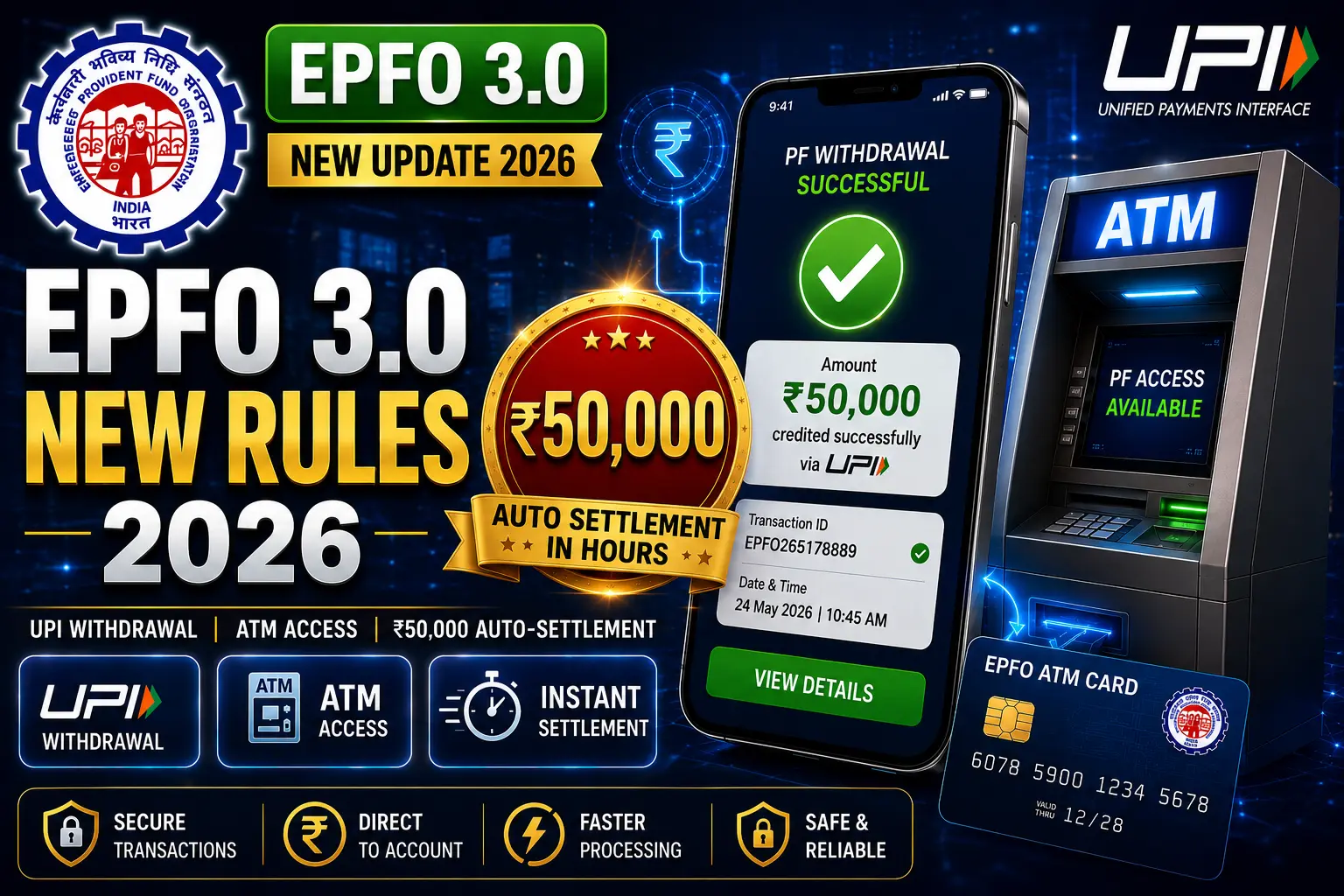
The biggest headline from EPFO 3.0 is UPI-based PF withdrawal. Members can withdraw their advance amounts (partial withdrawals) directly into their UPI-linked bank account—via apps like PhonePe, Google Pay, or Paytm.
The process: Log in to the EPFO member portal or UMANG app → select withdrawal → choose UPI as payment mode → enter UPI ID → authenticate via Aadhaar OTP → done.
This is primarily available for advance withdrawals (Form 31) during employment. Final settlement (Form 19) and pension claims (Form 10C) still follow standard banking channels for now.
Practical impact: An emergency medical withdrawal that used to take 10–15 working days can now be settled in hours—provided your KYC is complete.
2. EPFO ATM Card—Withdraw PF Like Cash
EPFO 3.0 proposes a dedicated ATM-like card for PF members. It is like a debit card but linked to your PF corpus. Members can swipe at any authorised ATM and withdraw directly, no internet required.
Key takeaways:
- You can take out no more than 50% of your eligible advance balance using an ATM card.
- The standard 25% limit remains in effect—there will always be a minimum balance retained.
- This service is designed for members without smartphones or internet connectivity.
Status: Expected to be launched in phases by mid-2026. Not yet universally live.
Risks to watch: ATM fraud risks apply here too—card skimming, PIN theft, and phishing. Treat your EPFO card with the same caution as your bank debit card.
The streamlining of partial withdrawal regulations will enable members to access funds more easily for vital life necessities such as education, marriage, and housing, all while maintaining long-term social security. – EPFO Central Board of Trustees
3. Auto-Settlement Up to ₹5 Lakh—Claims Without Human Review
This is arguably the most operationally significant change. Claims up to ₹5 lakh are now processed automatically by the system—no EPFO officer reviews them. If your UAN is active, KYC is complete (Aadhaar + PAN + bank account digitally approved), and the claim details match, money reaches you in a few hours to 3 business days.
For context: the previous auto-settlement limit was ₹1 lakh, and in FY 2024-25, EPFO processed 2.34 crore advance claims through auto-settlement – a 161% jump from the year before. By the midpoint of 2025, 95% of all advance claims were being settled through automation.
Urgent notice: Auto-settlement will not be active if your employer has not digitally approved your KYC on the EPFO portal. Rejections in 2026 are mainly caused not by member errors but by the employer’s KYC not being updated. If you are changing jobs, remember to request your new HR team to take care of this before you file a claim.
4. No More Employer Attestation
One of the most chronic pain points for salaried workers—having to chase ex-employers for claim signatures—is gone under EPFO 3.0.
If your Aadhaar is seeded with your UAN and KYC has been digitally approved by any previous employer, you can withdraw without any employer involvement. Authentication is done via Aadhaar OTP and self-certification.
Exception: If your KYC is incomplete, employer attestation becomes mandatory. There’s no workaround—so verify your KYC now, not when you need the money.
5. Simplified Withdrawal Categories—13 Becomes 3
The old 13-category withdrawal framework was confusing, condition-heavy, and inconsistent. EPFO 3.0 merges them into 3 clean buckets:
Category 1—Essential Needs: Medical emergencies (no minimum service requirement), education (up to 10 times), marriage (up to 5 times)
Category 2—Housing Needs: Home purchase, construction, or renovation (minimum 5 years service required)
Category 3—Special Circumstances: Permanent disability, relocation abroad, retirement, unemployment
Unemployment Withdrawal Rules: What Changed
If you resign, get laid off, or leave employment voluntarily, here’s how the new withdrawal timeline works:
| Stage | Condition | Withdrawal Allowed |
| Immediately | After leaving job | No withdrawal |
| After 1 month | Unemployed for 1 month | 75% of EPF balance |
| After 12 months | Unemployed for 12 months | Remaining 25% (full settlement) |
| EPS Pension withdrawal | After 36 months of unemployment | EPS corpus withdrawal allowed |
The 36-month EPS rule is a major change.
Previously, you could withdraw your EPS (pension) amount after just 2 months of unemployment. Now it’s 36 months—a full 3 years. This is designed to preserve pension savings, but it means workers who switch careers or go through extended unemployment face a long wait before accessing their EPS component.
Tax Rules: What’s New in 2026
The PF withdrawal tax guidelines have not changed much, but here’s a thorough overview:
After five years of continuous service: PF withdrawals are entirely tax-free.
- If you withdraw before five years and the amount exceeds ₹50,000, TDS will be deducted. The rate is 10% if your PAN is linked and 30% if it is not linked.
- For amounts under ₹50,000 or if you haven’t completed five years: You should file Form 15G (for individuals under 60) or Form 15H (for those 60 and older) to avoid TDS if your income is below the taxable limit.
- UPI withdrawals: The same tax provisions apply—the payment method does not determine tax liability.
- EPS pension: Monthly pension is taxable as income. Lump-sum EPS withdrawal (for those with less than 10 years of service) is taxed per slab.
One practical tip: if you’re withdrawing after exactly 5 years and 1 day, keep employment records ready. EPFO’s auto-system may still flag short-service exits.
How to Withdraw PF via UPI Under EPFO 3.0—Step by Step
Pre-check (do this first):
- UAN activated
- Aadhaar seeded with UAN
- PAN linked
- Bank account verified (digitally approved status)
- Mobile number linked to UAN active
Withdrawal Steps:
- Log in at epfindia.gov.in → Member UAN/Online Services
- Go to Manage → KYC → confirm all show “Digitally Approved.”
- Go to Online Services → Claim (Form 31, 19, 10C, 10D)
- Verify bank account (enter last 4 digits)
- Click “Proceed for Online Claim.”
- Select claim type: Form 31 for advance (partial) | Form 19 for full settlement
- Select a reason and payment mode—choose UPI and enter the UPI ID.
- Upload documents if prompted (usually not required for auto-settled claims).
- Authenticate via Aadhaar OTP
- Submit—track status under Online Services → Track Claim Status.
Helpline: 1800-118-005 (toll-free) | Grievance portal: epfigms.gov.in
EPS-95 Pension: What Changed and What Didn’t
What changed:
Digital Life Certificates (Jeevan Pramaan) can now be submitted from home via India Post Payments Bank (IPPB). EPFO bears the ₹50 service fee—free for pensioners.
Pension withdrawal waiting period after unemployment increased from 2 months to 36 months
The Centralized Pension Payment System (CPPS) ensures on-time credit to any bank across India.
What hasn’t changed (yet):
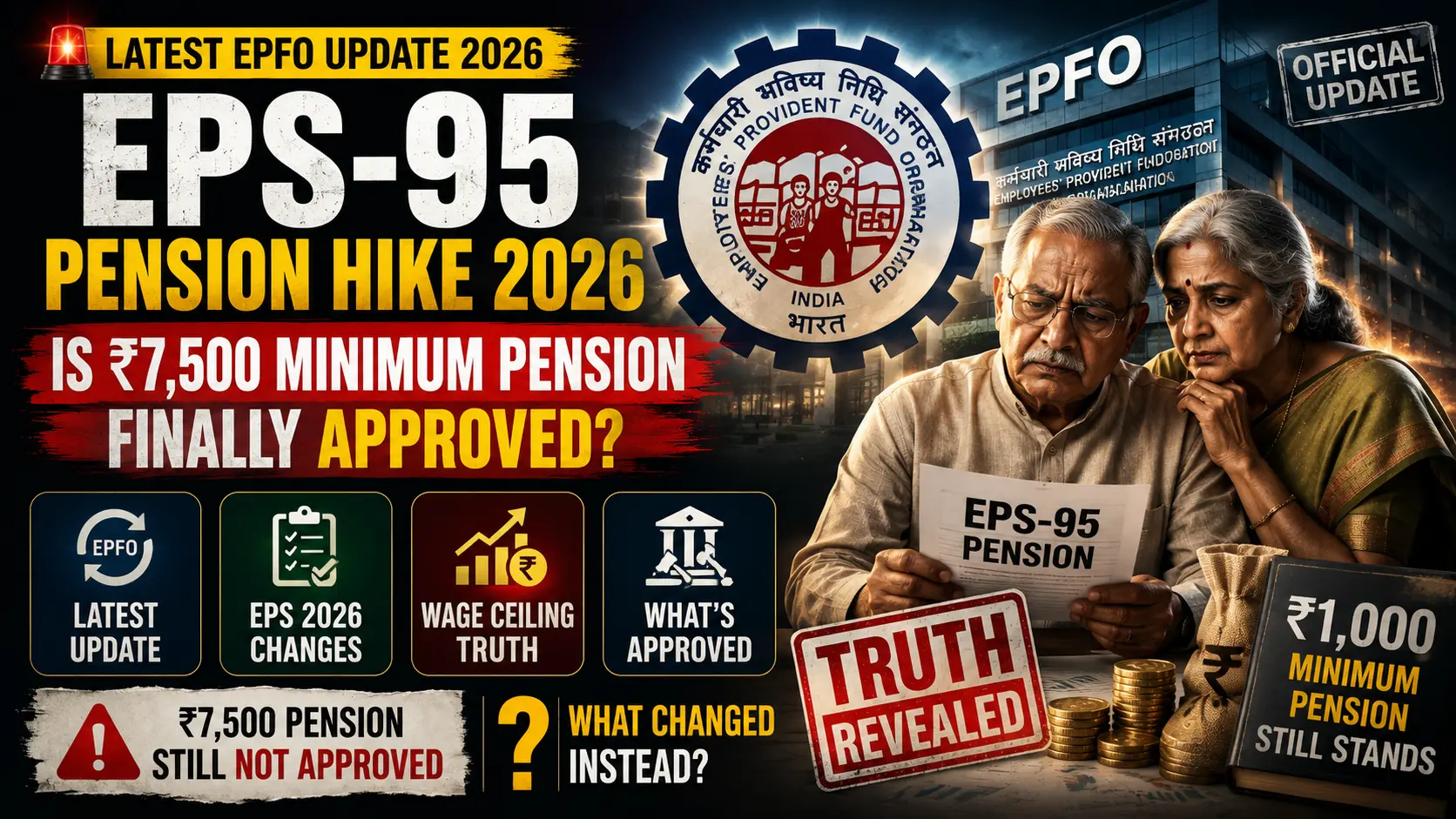
The EPS-95 minimum pension of ₹1,000/month remains unchanged. The long-demanded ₹7,500/month hike was NOT approved at the 238th CBT meeting. This remains under consideration.
The formula for pension is (Average Salary × Pensionable Service) ÷ 70, with a maximum salary of ₹15,000 per month in accordance with the EPS wage ceiling.
Eligibility for receiving an EPS pension requires a minimum of 10 years of contributory service.
Risks of EPFO 3.0 That No One Talks About
1. Risk of premature depletion
Ease of access has a downside. Members may give in to the lure of the withdrawal for non-essentials, as withdrawals linked to UPI are just a few taps away, eating into a retirement corpus that earns 8.25% per annum. The 25% floor does not entirely insulate against repeated partial withdrawals over a career.
2. ATM Fraud Risk
Dedicated PF ATM cards introduce card skimming, PIN theft, and phishing risks. Apply the same safety discipline you use with your bank card.
3. KYC Dependency
Without full, digitally approved KYC, you lose access to every EPFO 3.0 benefit — UPI withdrawal, auto-settlement, employer-free claims. The system is entirely KYC-dependent.
4. EPS Pension Squeeze
The 36-month wait to access EPS is tough on employees who work in unpredictable employment markets. A long-term break in a career or predetermined unemployment can lock pension funds for 3 years.
Expert Insight
EPFO 3.0 is a structural shift from a passive, paper-dependent system to an active, member-controlled one. The real benefit isn’t just speed—it’s the removal of employer dependency, which has historically been a leverage point for companies to delay ex-employee claims. However, the same ease of access that liberates members can undermine the system’s core purpose. India’s retirement savings gap is already significant. EPFO members withdrawing early under EPFO 3.0 are solving a short-term problem at a long-term cost. The architecture is sound—the question is whether members will exercise the discipline to use it wisely.
Key Takeaways
- EPFO 3.0 merges 13 withdrawal categories into 3, auto-settles claims up to ₹5 lakh, and removes employer attestation.
- UPI withdrawal and ATM card are the headline features—fully live, expected by mid-2026.
- 75% can be withdrawn after 1 month of unemployment; full settlement only after 12 months
- The EPS pension waiting period is now 36 months post-unemployment (up from 2 months).
- KYC completion is non-negotiable—without it, none of EPFO 3.0 works for you.
- PF withdrawal is tax-free after 5 years of continuous service; TDS applies to early withdrawals above ₹50,000.
- The ₹7,500 EPS minimum pension has NOT been approved yet—verify before publishing any claim.
EPFO New Rules FAQs: PF Withdrawal, EPS Pension & Claims
What is EPFO 3.0?
EPFO 3.0 is a digital evolution of India’s providing fund system that enables PF withdrawal through UPI or ATM card, automated settlement of PF claims up to ₹5 lakh, and eliminates compulsory employer- attestation requirements for KYC-verified members.
Can I withdraw PF via UPI in 2026?
It is possible to make advanced (partial) withdrawals using UPI in accordance with Form 31. You select UPI, provide your UPI ID, and authenticate with the Aadhaar OTP while processing your claim on the EPFO portal. Final settlement claims continue to be processed using NEFT.
What is the auto-settlement limit under EPFO 3.0?
Claims up to ₹5 lakh are auto-settled without any manual review, provided UAN is active and Aadhaar, PAN, and bank account KYC are digitally approved. This is up from the earlier ₹1 lakh limit.
Do I need employer approval to withdraw PF under EPFO 3.0?
Employer attestation is necessary if KYC is not complete. However, you can withdraw money through Aadhaar OTP-based self-attestation without engaging your employer if your Aadhaar is connected to your UAN & the KYC has been officially verified.
What is the EPS pension 36-month rule?
Under EPFO 3.0, you can only withdraw your EPS (pension) corpus after 36 months of unemployment—changed from the earlier 2-month rule. A monthly pension is available after retirement (age 58) with a minimum of 10 years of service.
How much PF can I withdraw via ATM card?
Up to 50% of eligible advance balance can be withdrawn via the EPFO ATM card. The 25% minimum floor always remains — you cannot access that portion until retirement or full settlement eligibility.
Is PF withdrawal taxable in 2026?
Once you decide to withdraw your PF before 5 years of ongoing service, you will be exposed to taxes. It is largely tax-free after five years. Before five years, withdrawals over ₹50,000 may be subject to TDS (10% once you have a PAN, 30% otherwise).
The Bottom Line: EPFO 3.0 Is Progress, But Discipline Is Still on You
EPFO’s 238th CBT meeting is a definitive milestone turning stage in improving the availability of provident funds and fortifying digital services for India’s salaried workforce. The long-expected EPS-95 pension hike is still under review, but the new EPFO 3.0 rules have already started making claims faster, automation smarter and processes more transparent for over 7 crore EPF members. With the digital transition of the Indian workforce, EPFO 3.0 is a building block towards easier, faster and reliable management of social security like never before.