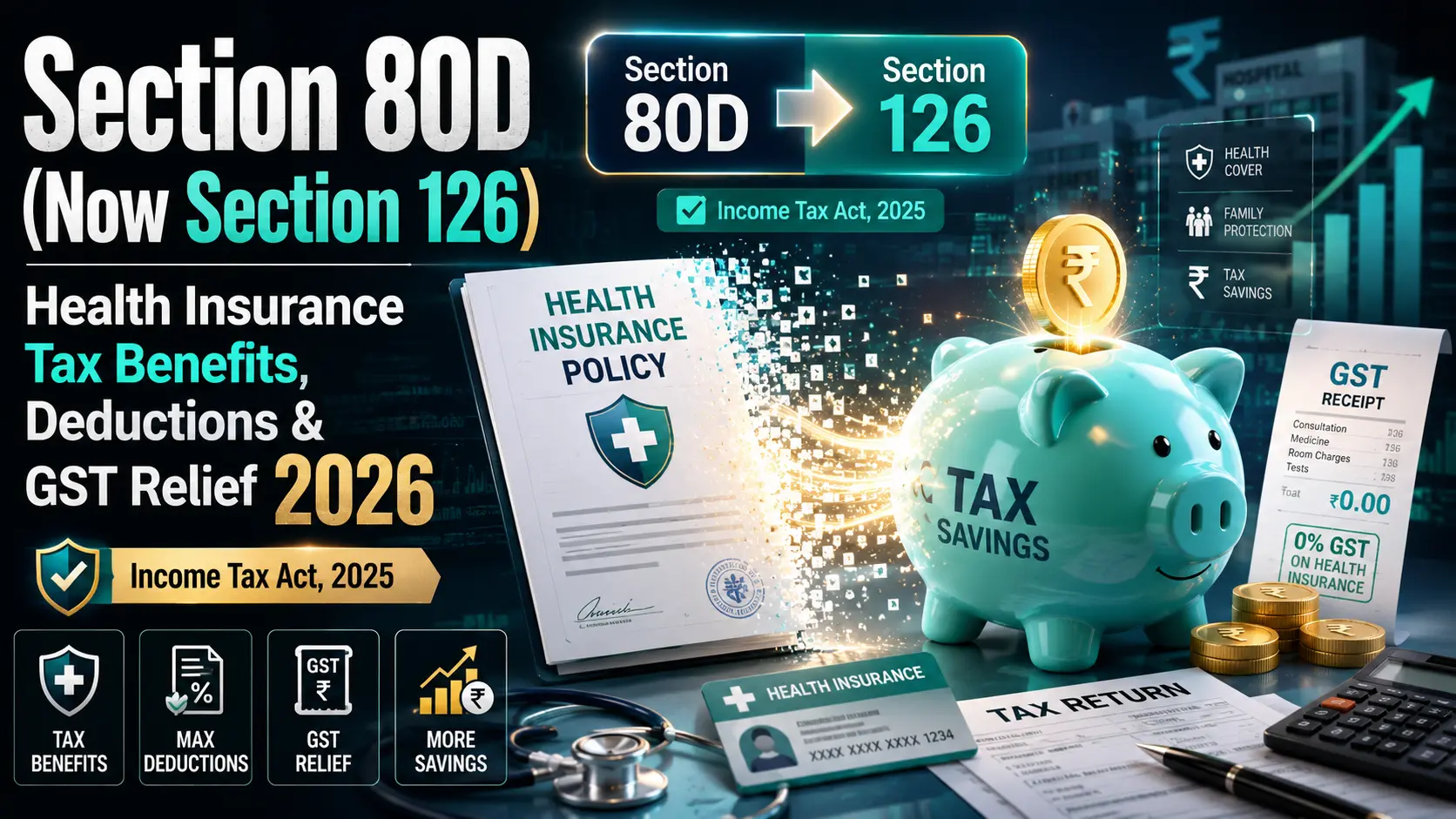
Health Insurance Tax Benefits: Medical costs are rising faster than most salaries. One hospital admission can wipe out years of savings—which is exactly why understanding tax benefits for health insurance matters, whether you are salaried, self-employed, or retired.
Under the Income Tax Act, you can claim deductions on health insurance premiums paid for yourself, your family, and your parents. Two things have changed recently that most guides haven’t caught up with: the section number itself has changed, and there’s now a documentation rule you can’t afford to miss while filing.
Here’s the complete, updated picture—with real ₹ examples, the mistakes to avoid, and exactly what’s different this year.
Section 80D Is Now Section 126 — Here’s What Actually Changes
The Income Tax Act, 1961, will be replaced by the Income Tax Act, 2025, with effect from April 1, 2026. The deduction provision for health insurance, which was earlier Section 80D, has been renamed as Section 126 with this reorganization.
The good news: it’s just the number that’s changed. The deduction limits, eligibility rules, and who qualifies remain the same under section 126 as they were under section 80D.
Here’s what counts for your filing this year:
| Filing | Applicable Law | Section Used |
| ITR for FY 2025-26 (AY 2026-27), filed from July 2026 | Income Tax Act, 1961 | Section 80D |
| Returns from Tax Year 2026-27 onwards (filed from July 2027) | Income Tax Act, 2025 | Section 126 |
So if you’re filing your return this year, you’ll still see “Section 80D” on your ITR form. Section 126 only takes over from next year’s filing cycle. Both names refer to the identical benefit — think of it as a renaming, not a new law.
Table of Contents
What Are Health Insurance Tax Benefits?
Health insurance tax benefits are the deductions you can claim on premiums paid for medical insurance covering yourself, your spouse, dependent children, and your parents. In simple terms: the government rewards you for insuring your family’s health by lowering your tax bill.
This benefit is available only under the old tax regime. If you’ve opted for the new tax regime (the current default under Section 115BAC), you cannot claim it—a point we’ll come back to below, since it was actively debated in this year’s budget.
How Health Insurance Works
Health insurance is a contract where you pay a premium, and in return, the insurer covers your medical expenses—hospitalisation, pre- and post-hospitalisation costs, daycare procedures, and cashless treatment at network hospitals.
Example: If your sum insured is ₹5 lakh and your hospital bill is ₹3 lakh, the insurer either settles it directly (cashless) or reimburses you, depending on your policy terms.
Types of Health Insurance Plans in India
In India, there are health insurance plans that cater to different requirements and age ranges. The main types are listed below:
| Plan Type | Best For |
| Individual Health Plan | One person, single premium and sum insured |
| Family Floater Plan | Couples/families sharing one sum insured |
| Senior Citizen Plan | Age 60+, covers age-related and pre-existing conditions |
| Critical Illness Plan | Lump sum on diagnosis of cancer, heart attack, stroke, etc. |
| Top-Up Plan | Extra coverage once your base sum insured is exhausted |
| Group Health Plan | Employer-provided, covers employees and sometimes dependents |
| Government Schemes | Ayushman Bharat, PMJAY — for economically weaker sections |
Deduction Limits Under Section 80D/126
| Who’s Covered | Maximum Deduction (FY 2025-26) | Key Notes |
| Self + Spouse + Dependent Children (below 60) | ₹25,000 | Family floater or individual policy |
| Parents (below 60) | ₹25,000 | Claimed separately from your own limit |
| Parents (60 or above) | ₹50,000 | Senior citizen benefit |
| Self (60+) + Parents (60+) | ₹1,00,000 | Combined maximum |
| Preventive Health Check-Up | ₹5,000 (within the above limit, not extra) | Can be paid in cash |
Parents are not required to be reliant—if you cover their premium, you are eligible for the deduction.
For example:
Priya (35) pays ₹18,000 for her family insurance and ₹40,000 for her 65-year-old parents.
Health Insurance Tax Benefits for Senior Citizens
Anyone aged 60 or above qualifies for the higher ₹50,000 deduction. If your parents are over 60 and you pay their premium—dependent or not—you can claim the deduction.
Example: You’re 35, and your parents are 65. You spent 20,000 on yourself and 45,000 on your parents. “Total payable = 65,000₹.
If your senior citizen’s parents lack insurance, you can claim up to ₹50,000 for their medical expenses.
Real Example: How Ramesh Saved ₹22,500
Ramesh, 40, an IT professional, paid ₹20,000 for his own family policy and ₹50,000 for his retired parents.
- Self + Family: ₹20,000
- Parents: ₹50,000
- Total deduction: ₹70,000
At a 30% tax slab, that’s ₹21,000 saved, plus ₹1,500 more from the preventive check-up component — ₹22,500 in total tax savings.
The New ITR Documentation Rule You Can’t Skip
ITR forms want you to declare your insurer’s name and policy number while claiming a deduction under Section 80D from Assessment Year 2025-26. This is applicable whether you are filing ITR-1, ITR-2, or any other form that applies to you. Please gather your policy documents and review them before filing.
Tip: Always use digital payments and keep receipts for ITR filing.
Will Section 80D/126 Be Available Under the New Tax Regime?
Short answer: not yet. Ahead of Budget 2026, the Institute of Chartered Accountants of India (ICAI) formally recommended allowing deductions for health insurance premiums under the default (new) tax regime, arguing that its unavailability discourages responsible health coverage planning. Industry economists provided similar suggestions.
The government did not accept this proposal. As things stand for FY 2025-26, Section 115BAC—the new tax regime—still does not permit an 80D/126 claim, regardless of your income level. If you’re paying meaningful health insurance premiums (roughly ₹25,000-₹75,000 across yourself and your parents), that’s a real factor in deciding whether the old regime works out cheaper for you overall — worth running the numbers before you commit either way.
Common Mistakes to Avoid Get Health Insurance
- Paying premiums in cash—not allowed (preventive check-ups are the one exception).
- Claiming for siblings or friends—not eligible under this section
- Forgetting the preventive check-up component (₹5,000, within the overall limit)
- Choosing the new tax regime and expecting to still claim 80D/126
- Not entering your insurer’s name and policy number in the ITR—required since AY 2025-26
- Double-counting overlapping family and individual plan premiums
GST on Health Insurance Premium in India (Old vs New)
In earlier times, health insurance premiums in India were charged an 18% GST, which raised the overall policy costs. For example, a base premium of ₹10,000 would incur an additional ₹1,800 in taxes.
However, starting from 22 September 2025, the government has introduced a new GST rule that removes GST (0%) on individual and family floater health insurance policies. This important change makes health coverage 18% less expensive and encourages a greater number of people to obtain insurance.
Groups or employer-based health plans still face an 18% GST, but individual policyholders now enjoy savings through reduced premiums and health insurance tax benefits under Section 80D.
What This Indicates for You:
- Reduce your costs for the same level of coverage—or gain increased coverage for the same price (e.g., ₹10L → ₹12L).
- Pair lower premiums with health insurance tax benefits under Section 80D for double savings.
- Note: Group- or employer-provided health plans are still liable for 18% GST.
Top 10 Tax-Saving Health Insurance Tips (2025)
- Acquire early—insurance premiums are more budget-friendly.
- Use digital payment methods for tax eligibility.
- Opt for family floater plans to achieve maximum cost efficiency.
- Acquire multi-year insurance plan to maintain premium rates.
- Incorporate parents’ insurance to increase the deduction limit.
- Keep receipts and payment evidence ready for ITR.
- Make use of the preventive check-up benefit (₹5,000).
- Notify your insurer with your Permanent Account Number (PAN) information.
- Consider top-up plans for enhanced coverage.
- Conduct an annual review of your coverage—needs may vary.
How to Choose the Best Health Insurance Plan
- Sum Insured: At least ₹10–₹15 lakh for those living in metro areas.
- Room Rent Limit: Ideally “no cap” or a private room.
- Waiting Period: 2–3 years (the shorter, the more favorable).
- Co-Pay (80/20 Rule): Steer clear if you are young.
- Cashless Network: Should include major hospitals in the area.
- No-Claim Bonus: Helps to boost coverage each year.
- Add-Ons: Only use if required (maternity, OPD, critical illness).
Quick Formula to Calculate Health Insurance Tax Benefits
Tax Saved = Section 80D/126 Deduction × Your Tax Bracket Rate
Example:
₹67,000 deduction × 20% tax rate = ₹13,400 saved every year
At 30%, ₹20,100 is saved every year.
This shows how health insurance tax benefits make your policy a financial protection and a smart investment.
FAQs About Health Insurance Tax Benefits
Is Section 80D still called Section 80D, or has it changed?
Both names apply, depending on when you’re filing. For FY 2025-26 (AY 2026-27), filed from July 2026, you’ll use Section 80D under the Income Tax Act, 1961. From Tax Year 2026-27 onwards (filings from July 2027), the same benefit is claimed under Section 126 of the Income Tax Act, 2025. The limits and rules are identical either way.
What is the maximum deduction under Section 80D/126 for FY 2025-26?
Up to ₹25,000 for yourself, your spouse, and dependent children under 60. This rises to ₹50,000 if anyone insured is a senior citizen. You can claim an additional ₹25,000 or ₹50,000 separately for your parents, depending on their age. The maximum possible deduction is ₹1,00,000, when both you and your parents are senior citizens.
Do I need to mention my insurer’s name and policy number while filing ITR?
Yes. Since AY 2025-26, this has been mandatory across all applicable ITR forms for anyone claiming a Section 80D deduction.
Will Section 80D/126 be available under the new tax regime?
Not currently. Despite ICAI’s pre-Budget 2026 recommendation to allow this deduction under the default tax regime, it was not incorporated. The new tax regime under Section 115BAC still disallows this deduction for everyone.
Can I claim tax benefit if my employer provides group health insurance?
Only for the portion you personally pay — for instance, a salary deduction or a voluntary top-up on the group policy. If your employer covers the entire premium, there’s no expense on your part to claim.
Is preventive health check-up covered under Section 80D/126?
Yes, up to ₹5,000 per year, within your overall limit (not additional). It’s the only component you can pay for in cash.
Can I claim tax benefits for parents who aren’t financially dependent on me?
Yes. Financial dependency isn’t a requirement — only that you pay the premium through a digital mode.
Is GST still charged on health insurance premiums?
Not for individual and family floater policies — GST was removed (0%) from 22 September 2025. Group or employer-provided plans still attract 18% GST.
Can I claim both Section 80C and Section 80D/126 together?
Yes, they’re independent deductions. You can claim up to ₹1,50,000 under 80C and the applicable limit under 80D/126 in the same year.
Final Thoughts on Health Insurance Tax Benefits in 2026
Health insurance isn’t just medical protection—it’s one of the smartest ways to save on tax legally under Section 80D while securing your family’s health. Buy the right policy, pay premiums digitally, and unlock health insurance tax benefits every year. If your parents are senior citizens, insure them separately to claim higher deductions and double the advantage.
The earlier you buy, the lower the premium—and the longer you enjoy tax savings.