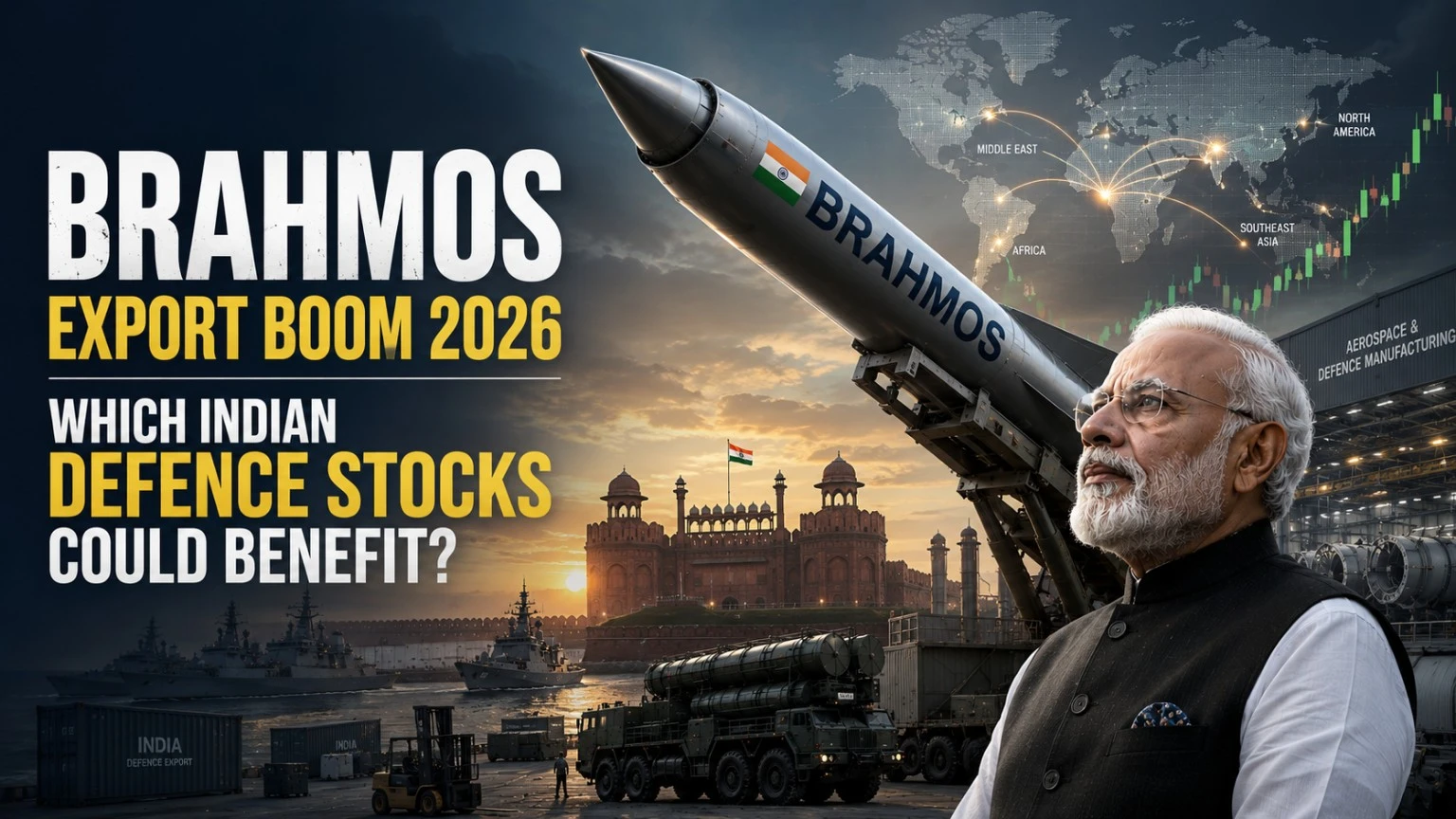
If you’ve been even half-watching business news this month, you’ve probably seen the headlines: India has signed a ₹5,800 crore deal to export the BrahMos supersonic cruise missile to Vietnam, with a similar agreement for Indonesia reportedly in its final stages. For a country that was largely an arms importer for decades, this is a genuinely big moment—and it’s the kind of story that tends to get retail investors typing “defense stocks to buy” into Google.
But here’s the thing most people miss: you can’t actually buy BrahMos Aerospace. It’s an unlisted Indo-Russian joint venture between DRDO and Russia’s NPO Mashinostroyeniya. So if the missile itself isn’t on the stock exchange, how does an investor play this theme at all?
The answer lies in the supply chain—the listed Indian companies that build the parts, systems, and platforms feeding into BrahMos and India’s broader defense export push. This article breaks down exactly which Indian defense stocks are connected to this story, what their numbers currently look like, and what risks you should weigh before getting swept up in the excitement.
What’s Actually Happening With BrahMos Exports
BrahMos exports are quickly becoming one of the major drivers of growth in India’s defence industry. Vietnam will be the second country in Southeast Asia to acquire the BrahMos missile system after the Philippines in a deal of about ₹6,000 crore.
Though countries such as the United Arab Emirates, Egypt, Malaysia, Oman and South Africa have shown interest, Indonesia is also moving forward with procurement, and investors see the deal as more than a one-off export buy.
BrahMos is becoming a major part of India’s plan to raise defence exports to ₹50,000 crore per year by 2030.
With global demand rising, a multi-year export opportunity could be useful for a number of Indian defence industries working on electronics, weapon systems, and missile manufacturing.
Table of Contents
Why Investors Can’t Buy BrahMos Directly—But Can Buy Its Ecosystem
BrahMos Aerospace is unlisted, so investors cannot buy its shares directly. Instead, they can gain exposure through listed defence companies linked to the broader BrahMos ecosystem.
Key stocks include:
- Bharat Dynamics (BDL) – India’s leading missile PSU with a ₹26,000+ crore order book.
- Hindustan Aeronautics (HAL) – a defence giant with a ₹2.5 lakh crore+ order book.
- Solar Industries India manufactures indigenous boosters used in BrahMos missiles.
- Jindal Stainless supplies specialised materials for missile and aerospace projects.
The real investment opportunity lies in India’s expanding defence export ecosystem. With a target of ₹50,000 crore defence exports by 2030, these companies could benefit from a long-term growth cycle.
| Company | Role in Defence Ecosystem | Key Highlight |
| Bharat Dynamics (BDL) | Missile systems and launchers | ₹26,000+ Cr order book |
| Hindustan Aeronautics (HAL) | Aircraft and defence manufacturing | ₹2.5 Lakh Cr+ order book |
| Solar Industries India | BrahMos missile boosters | Strong private-sector defence play |
| Jindal Stainless | Defence-grade materials and components | Indirect exposure to defence exports |
While investors cannot buy BrahMos Aerospace directly, these companies offer exposure to India’s growing defence export story. As defence exports target ₹50,000 crore by 2030, the broader ecosystem could benefit from long-term growth opportunities.
Expert Insight
India’s defence exports are not limited to just one BrahMos contract. The real opportunity is in the broader ecosystem – defence materials, propulsion, aircraft, and missiles. Investors should avoid chasing short-term news-driven rallies and focus on companies with high-quality execution, high order inflows and repeat exposure,” he said.
Key Takeaways
- BrahMos Aerospace is not listed, and investors only have an indirect exposure to the company along reputable companies including BDL, HAL, Solar Industries, and Jindal Stainless.
- The contracts signed with Vietnam as well as Indonesia highlight India’s growing eagerness to sell military hardware.
- Execution even with the size and large order book of HAL is a big risk.
- BDL has good order visibility despite the possibility of earnings fluctuations.
- Solar Industries, which makes boosters, is one of the closest to the BrahMos initiative.
- The defence exports are expected to grow exponentially with India’s target to export ₹50,000 crore by 2030.
Frequently Asked Questions (FAQs) About Indian Defence Stocks
1. Can I invest directly in BrahMos Aerospace?
No. BrahMos Aerospace is unlisted. Investors can only gain exposure through listed defence and supply-chain companies.
2. Which defence stocks benefit most from BrahMos exports?
BDL, HAL, Solar Industries, and Jindal Stainless are among the key companies linked to the broader BrahMos ecosystem.
3. Is it too late to invest in defence stocks?
Not necessarily. While valuations have risen, India’s defence export growth story could continue for years if execution remains strong.
4. Why did BDL fall despite winning new orders?
Defence companies often face execution delays, meaning strong order books don’t always translate into immediate revenue or profit growth.
5. What are the biggest risks?
Execution delays, high valuations, geopolitical factors, and dependence on government defence spending.
Final Verdict: The Real Investment Opportunity Behind BrahMos Exports
The BrahMos export boom is an important milestone for India’s defence sector, but the bigger opportunity lies in the companies supporting this ecosystem. Rather than chasing headlines, investors should focus on businesses with strong order books, recurring defence contracts, and proven execution. For long-term investors, India’s defence export push could remain a powerful growth theme throughout the decade.