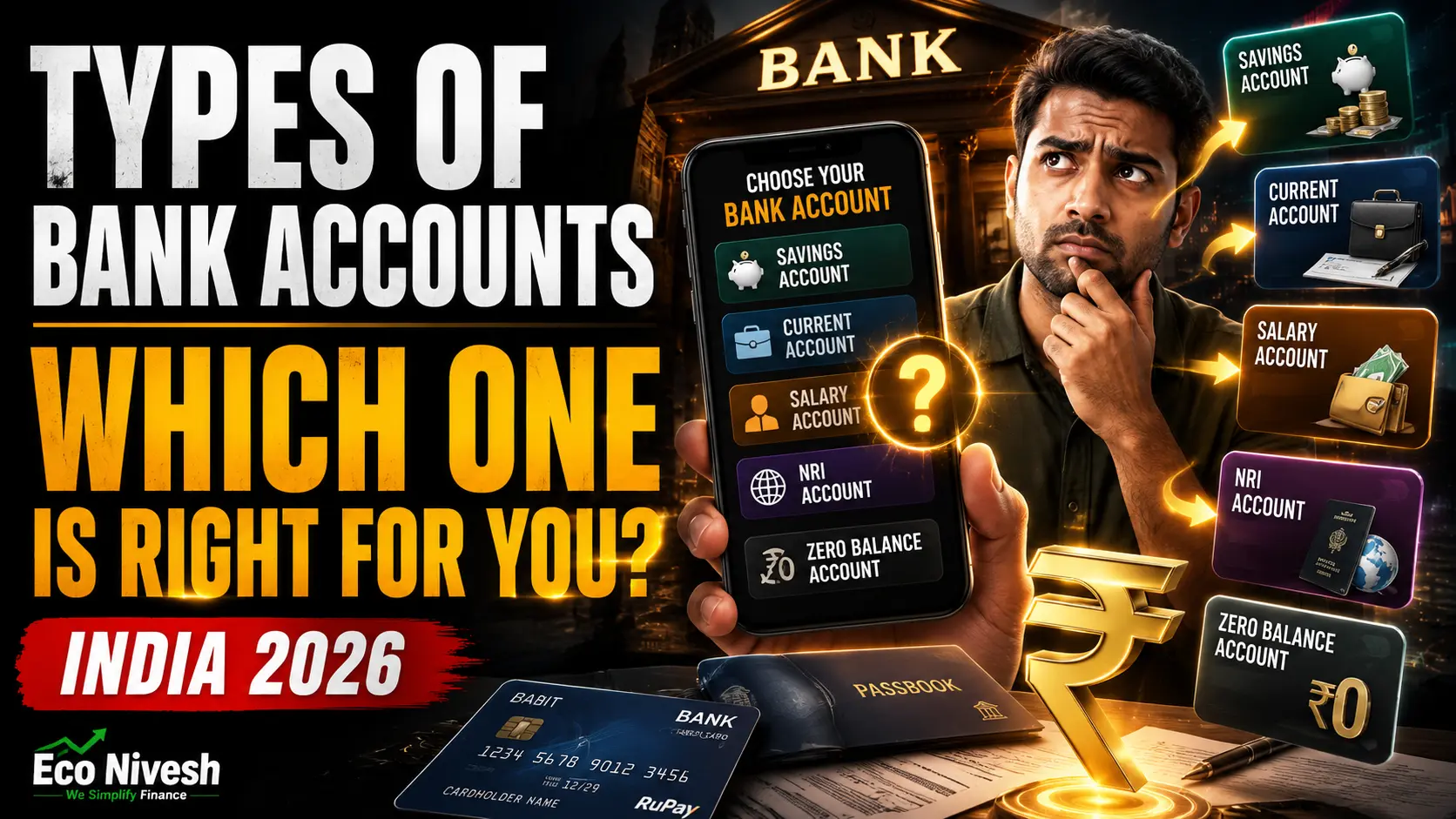
Types of Bank Accounts In India: Opening a bank account sounds simple—until you’re standing at the branch and the executive asks, “Savings or current? Regular or zero-balance? Resident or NRI?” Most people default to whatever account their first employer or parent set up for them and never revisit the choice even when their needs change completely.
That’s a mistake. The right account can save you on minimum-balance penalties, get you better interest, or unlock features you didn’t know existed—like a Section 80D-linked health cover savings account or a zero-balance account that never charges a maintenance fee. The wrong one quietly drains money through charges you never notice.
This guide breaks down every major type of bank accounts available in India in 2026—who it’s for, what it costs, and how to pick the right one.
Why the Type of Bank Accounts You Choose Actually Matters
Every bank account in India is regulated by the Reserve Bank of India (RBI), but the rules, interest rates, minimum balance requirements, and transaction limits vary sharply between account types. A current account, for instance, earns no interest at all but allows unlimited transactions—ideal for a business, disastrous for someone just trying to save. A savings account does the opposite.
As of the RBI’s August 2026 Monetary Policy Committee review, the repo rate stands at 5.25%, and most savings account interest rates across major banks now range between 2.5% and 7% per annum, calculated on your daily closing balance. The key to making your money work for you is choosing the right account for your needs, not the one your bank pushed.
Table of Contents
1. Savings Account
Hence, the savings account is the highest account type in India. This is for people who want to keep their money safe and get a little bit of interest.
Best for: Salaried, student, homemakers, retirees, and anyone dealing with personal income and expenses.
Features brief:
- Interest is calculated daily and credited quarterly or half yearly (as per RBI’s advisory in favor of crediting quarterly for the benefit of customers).
- Minimum balance requirements vary by bank—typically ₹0 to ₹10,000, and often waived for salary or student variants.
- Comes with a debit card, checkbook, net banking, and UPI access
- Deposits are insured up to ₹5 lakh per depositor per bank under the DICGC (Deposit Insurance and Credit Guarantee Corporation).
Types of Bank Accounts: Regular Savings Account
- basic features and minimum balance required
- Zero deposit/Basic Savings Bank Deposit Accounts (BSBDAs) as mandated by RBI have no minimum deposit requirements, simplified KYC, and are meant to promote financial inclusion. Each bank can have only one BSBDA.
- Salary Account – It usually comes with benefits like free demat accounts or discounted loans. It does not require any balance as long as salary is credited every month.
- Senior Citizen Savings Accounts offer priority service and higher interest rates (usually 0.25%–0.75% above ordinary rates).
- Women’s Savings Account: offers some, often better locker rates. Kids/Minor Savings Accounts: Designed to encourage early financial habits and controlled by parents/guardians until the child reaches age 18.
- Younger, mobile-first users love digital savings accounts with fully paperless KYC and app-only banking.
2. Current Account
A current account is built for high transaction volume, not for earning interest—in fact, current accounts pay no interest at all in most cases.
Perfect for Business owners, freelancers, micro, small and medium enterprises and professionals who regularly make high value transactions.
Key features:
- No cap on daily deposits or withdrawals
- Overdraft facility available against collateral or banking relationship
- Higher minimum balance requirement than savings accounts (often ₹10,000–₹25,000 or more, scaling with account tier)
- Requires business proof and GST/registration documents in addition to standard KYC
- If you’re not running a business or professional practice, banks generally steer you toward a savings account instead—a current account without business activity is usually not the right fit.
Banks now offer tiered current accounts — for instance, a “Lite” tier for small businesses with modest transaction needs, and an “Elite” or “Ultra” tier for high-turnover businesses needing cash management and payment gateway integration.
3. Salary Account
- Technically a variant of the savings account, but worth calling out separately because of how differently it’s structured.
- Best for: Anyone employed by a company that has a corporate salary tie-up with a bank.
Key features:
- Zero balance requirement as long as salary credits continue
- If salary stops for a few months (job change, career break), the account typically converts to a regular savings account, and minimum balance rules kick in.
- Often bundled with free personal accident cover, discounted loan processing fees, and complimentary debit card upgrades
4. NRI Account (NRE, NRO, FCNR)
Under the Foreign Exchange Management Act (FEMA), 1999 RBI has prescribed some types of accounts for non-resident Indians, persons of Indian origin and overseas citizens of India. Once you switch your residence status, you are legally required to convert your resident savings account into one of these. If you operate a normal resident account as an NRI, it can be frozen.
| Account Type | Currency Held | Best For | Repatriation | Taxability in India |
|---|---|---|---|---|
| NRE (Non-Resident External) | Indian Rupees | Foreign income you want to bring into India | Fully repatriable (principal + interest) | Interest is tax-free in India |
| NRO (Non-Resident Ordinary) | Indian Rupees | Income earned in India—rent, dividends, pension | Repatriable up to USD 1 million/financial year after taxes | Interest is taxable in India, TDS applies |
| FCNR (Foreign Currency Non-Resident) | Foreign currency (USD, GBP, EUR, etc.) | Parking foreign earnings without currency conversion risk | Fully repatriable | Interest is tax-free in India |
Best NRE Saving Account Interest Rates 2026 Best banks will offer NRE savings account interest rate between 6.5% to 7.25%. The interest rates are attractive for NRIs who do not want to get quick cash in rupees outside India.
5. Fixed Deposit (FD) and Recurring Deposit (RD) Accounts
These are not transaction accounts. But for completeness, they should be included.
- Fixed Deposit: It is a mode of investing a particular sum of money at a fixed rate of interest for a period of time. Normally a penalty is imposed for premature withdrawal.
- Recurring Deposit: It is a fixed amount recurring deposit for a specified period. This type of deposit is an effective way to develop a saving habit without requiring a large initial amount.
Both come under the same Rs 5 lakh insurance cover limit of DICGC for each depositor for each bank—which means for all types of deposits in that bank and not per account.
6. Basic Savings Bank Deposit Account (BSBDA)
Worth a dedicated mention because of its role in financial inclusion. This is an RBI-mandated no-frills account requiring no minimum balance and simplified KYC, meant to bring unbanked and underbanked populations into formal banking. You can hold only one BSBDA per bank—if you already have a regular savings account at that bank, you can’t open a BSBDA there too.
7. Rural and Government Scheme Accounts
Some of the accounts that some of the banks offer specifically for rural and welfare purposes are Kisan Club Savings Accounts, government-backed Scheme Beneficiary Accounts (for direct transfer of benefits in the form of subsidies), institutional-specific accounts for farmer organizations and cooperative societies, etc. These accounts are more liberal in terms of KYC and documentation requirements, considering that they are designed to meet the needs of their target demographic.
8. Demat-Linked and Institutional Accounts
Not a “bank account” in the traditional sense, but increasingly bundled with savings accounts—a demat account for holding shares and securities is often opened alongside a savings account when you start investing. Institutional and trust accounts serve NGOs, societies, and corporate entities with their own compliance requirements.
Types of Bank Accounts: Savings vs Current Account — Key Differences
This is the single most-searched comparison in this space, so it deserves a direct answer:
- Savings account—earns interest, meant for individuals, has withdrawal limits at some banks, lower minimum balance
- Current account—earns no interest, meant for businesses, unlimited transactions, overdraft facility, higher minimum balance
If you’re not running a business, a savings account is almost always the right choice.
How to Choose the Right Type of Bank Account in 2026
- Are you employed or self-employed/running a business? Employed → savings/salary account. Business → current account.
- Do you need zero balance? Look at BSBDA or salary account options.
- Are you an NRI? You legally need NRE/NRO/FCNR, not a resident savings account.
- Do you want your money to earn while sitting idle? Compare savings account interest rates or consider a sweep-in FD linked to your savings account.
- What’s your transaction volume? High-frequency, high-value transfers point toward a current account even for freelancers and gig workers past a certain scale.
Key Takeaways
There are about 8 useful types of bank accounts in India, the two basic ones being current and saving accounts.
- Corporate accounts are unlimited but don’t earn interest. Savings accounts are interest-bearing accounts for individuals.
- As per law, NRIs cannot hold resident accounts. They can only hold NRE, NRO, or FCNR accounts. The DICGC insurance covers all deposits up to ₹ 5 lakh for each depositor in each bank for all types of accounts.
- The RBI repo rate was maintained at 5.25% in the August 2026 MPC review, so savings account and FD rates are largely unchanged for now.
Frequently Asked Questions (FAQs) About: Types of Bank Accounts In India
Q1: How many types of bank accounts are there in India?
There are broadly eight practical categories: savings, current, salary, NRI (NRE/NRO/FCNR), fixed deposit, recurring deposit, BSBDA (zero-balance), and rural/government scheme accounts. Within these, banks offer dozens of branded variants.
Q2: What is the minimum balance required for a savings account in India?
They have a range of ₹0 (zero balance/BSBDA accounts) to ₹10,000 or more for premium savings accounts, depending on the bank and account type. Salary accounts usually waive the minimum balance requirement altogether as long as salary is credited monthly.
Q3: Can I open a savings account with zero balance?
Yes. RBI has directed all the banks to open Basic Savings Bank Deposit Account (BSBDA) for the purpose of financial inclusion with simplified KYC and without the minimum balance requirement.
Q4: What is the difference between NRE and NRO accounts?
Foreign income converted into rupees is maintained in an NRE account and earns tax-free interest and full repatriation. An NRO account is for income earned in India, like rent or dividends, and the interest earned is taxable in India and is capped at USD 1 million per financial year after tax for repatriation.
Q5: Is my money safe if my bank fails?
The DICGC, a subsidiary of the RBI, insures deposits in a bank’s savings, current, fixed deposit, and recurring deposit accounts up to ₹5 lakh for each depositor (original amount plus interest). Amounts over this limit are not insured.
Types of Bank Accounts: Choosing the Right Bank Account for You
Choosing a bank account isn’t a one-time decision you make and forget—it’s worth revisiting every time your life stage changes. A student moving into their first job should graduate from a zero-balance account to a salary account; a freelancer scaling into a registered business should move from a personal savings account to a current account; an NRI returning to India needs to convert accounts entirely to stay compliant. The account types covered in this guide—savings, current, salary, NRE, NRO, FCNR, FD, RD, and BSBDA—cover almost every financial situation an Indian resident or NRI can be in. The safest approach is simple: match the account to how you actually use your money, not to what a bank counter recommends by default, and recheck that fit whenever your income, employment status, or residency changes.