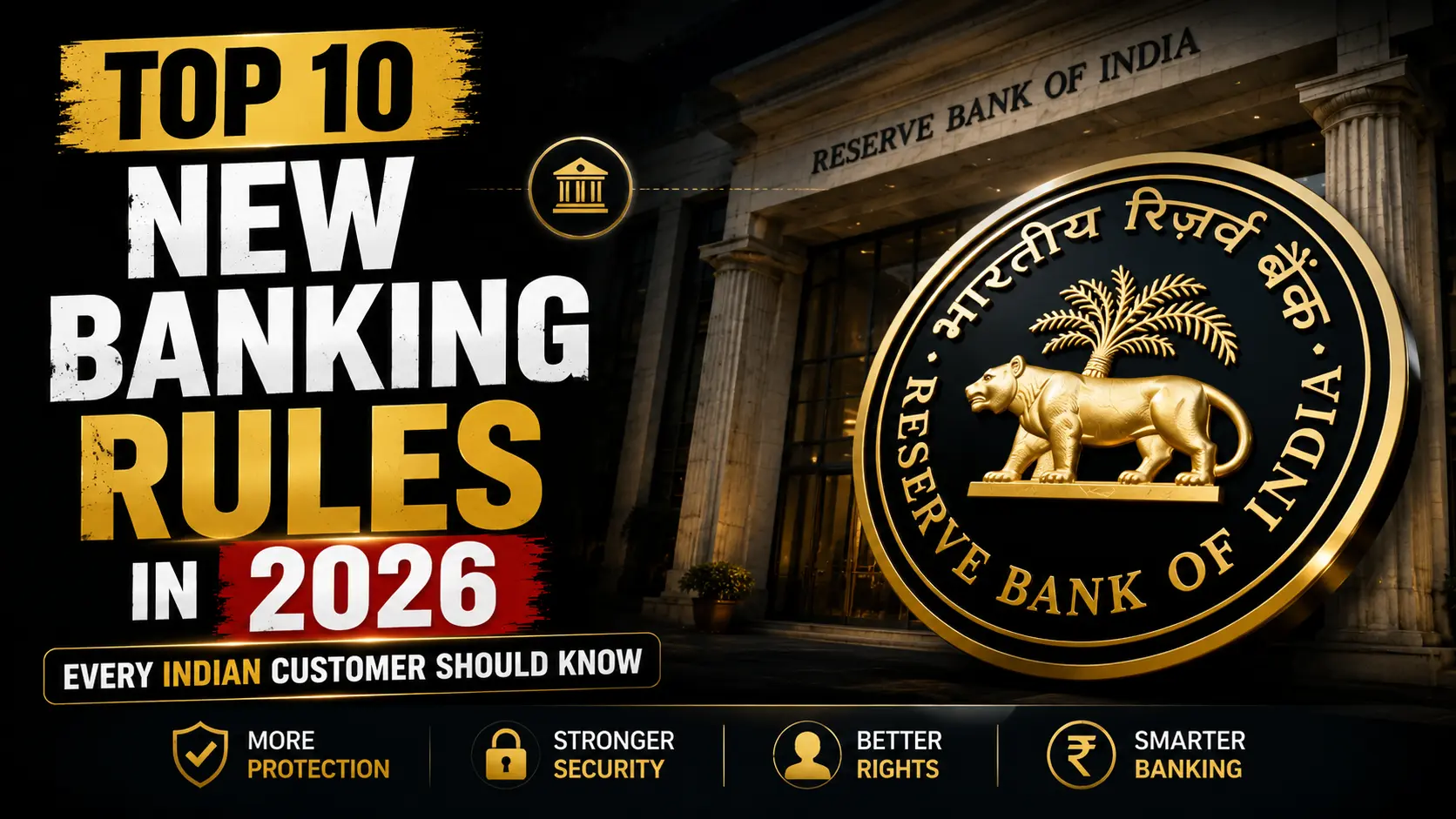
New Banking Rules in 2026: If you have a savings account, a home loan, or even just a debit card, 2026 has quietly changed how your bank treats you. Most of the coverage on these changes reads like a compliance memo—long, jargon-heavy, and written for bankers, not for you.
This guide skips the legalese. Here are the 10 banking rules that actually affect your money in 2026, what triggered each one, and exactly what you should do about it.
1. No Foreclosure Penalty on Floating-Rate Loans
Until now, paying off your home or personal loan early could cost you 2–4% of the outstanding amount as a foreclosure or prepayment penalty. From April 1, 2026, the RBI has removed this penalty entirely on floating-rate loans taken by individual borrowers, along with some MSME loans.
Example: If you have a ₹40 lakh floating-rate home loan and get a bonus you want to put toward prepayment, you keep the full amount—no ₹10,000–20,000 penalty deducted.
What to do: If you’re sitting on surplus cash and a floating-rate loan, prepaying now costs you nothing extra. Please review your loan agreement to ensure it is a floating-rate loan, as fixed-rate loans are not included.
2. Multi-Nomination Facility: Up to 4 Nominees Allowed
You can now name up to 4 nominees for a single savings account, fixed deposit, or locker, instead of just one. This is meant to prevent the classic problem of a family being stuck in legal limbo because the sole nominee had passed away or was unreachable.
Important clarification: A nominee is not the legal owner of the money. Nomination only tells the bank who to hand the funds to for safekeeping—legal heirs (as per a will or succession law) still have the final claim if there’s a dispute. Adding nominees makes it easier to process at the bank level but doesn’t change inheritance law.
Even with one nominee, update your nomination forms across all accounts, FDs, and lockers. It costs nothing and saves your family from paperwork later.
3. Faster Credit Score Updates: Weekly Reporting
Banks and NBFCs previously reported your loan and credit card activity to bureaus like CIBIL every 15 days. Through 2026, the RBI is shifting this to a weekly cycle—data is reported roughly every 7 days instead of fortnightly.
What the change means for you:
- Pay your EMIs on time, and your score improves faster.
- Miss a payment, and it shows up on your credit report within days, not weeks.
What to do: If you’ve been relying on the old 30–45 day lag to “catch up” on a missed payment before it hits your score, that buffer is disappearing. Set up auto-debit for EMIs to avoid slip-ups.
4. UPI Withdrawals Now Count Toward Your Free ATM Limit
Previously, UPI ATM withdrawals did not count toward your debit card’s free withdrawal limit. From April 1, 2026, both are clubbed together. You get 3 free withdrawals a month in metro cities and 5 in non-metro cities—combined across UPI and debit card. Beyond that, each withdrawal attracts a charge of around ₹23 plus GST.
If you make frequent use of the Unified Payments Interface (UPI) and your debit card for cash withdrawals, it is important to keep track of your usage so that you are not taken aback at the end of the month.
5. Mandatory 2FA on Every Digital Payment
The RBI has tightened its Additional Factor of Authentication (2FA) requirements across all digital payment channels — cards, UPI, net banking, and wallets — from April 1, 2026. Any bank or fintech app relying on a single-factor flow (just a PIN, for instance, with no dynamic second check) is now out of compliance.
What to do: You’ll likely notice an extra verification step on payments that previously went through in one tap. This is a security upgrade, not a glitch — don’t disable it even if it feels like friction.
Table of Contents
6. Silver Accepted as Loan Collateral, Alongside Gold
For the first time, RBI rules allow silver ornaments and coins to be pledged as collateral for a loan, in addition to gold. This effectively widens the pool of assets Indian households can use to raise emergency funds.
What to do: Individual bank policies still vary on the purity standards and form of silver accepted, so confirm directly with your bank before assuming your silver jewellery qualifies.
7. Dormant Accounts Are Never “Lost” Without Notice
From January 1, 2026, banks must follow a clearer, more transparent process before freezing dormant accounts (no activity for 2 years) or inactive accounts. Customers must be notified in advance and given a fair window to reactivate the account before restrictions kick in.
What to do: If you maintain accounts across multiple banks—common for salaried professionals who’ve switched jobs—check for any account you haven’t touched in a while and do a small transaction to keep it active, or formally close it.
8. Zero Liability on Unauthorized Transactions
This isn’t a brand-new rule, but RBI has reinforced it strongly as digital fraud has increased. If money is taken from your account without your consent — through UPI fraud, a SIM swap, phishing, or card misuse — and you report it within 3 working days, you get zero liability, meaning a full refund, provided you weren’t negligent.
What to do: Save your bank’s fraud helpline number somewhere accessible, not just in your contacts (in case your phone is compromised). The moment you notice an unauthorised transaction, call and block your card/UPPI first, then file a written complaint.
9. Mandatory Bundling of Products Prohibited (Coming January 2027)
This one is still ahead of us, but it’s worth knowing now: from January 1, 2027, banks will be barred from “compulsory bundling” — the practice of forcing you to buy an insurance policy or credit card as a condition for getting a loan. If a bank insists you need a risk-mitigant product like term insurance for a home loan, you’ll have the right to buy it from any provider, not just the bank’s in-house partner. Mis-sold products will require a full refund plus compensation.
What to do: If a bank is currently pressuring you into a bundled product for a loan you’re taking now, you can push back and ask whether the third-party product is genuinely mandatory or just standard sales practice.
10. Fairer Loan Recovery Conduct
Banks and their recovery agents can no longer harass borrowers or their relatives to recover a defaulted loan. Recovery calls and visits are restricted to between 8 AM and 7 PM, and repeated pressure tactics can lead to penalties or even suspension of the recovery agent’s license.
What to do: If you’re behind on payments and facing calls outside these hours or aggressive behavior from a recovery agent, you can file a formal complaint with the bank and escalate to the RBI Banking Ombudsman if unresolved.
Key Takeaways
- Floating-rate loan holders can prepay penalty-free from April 1, 2026 — a genuine money-saver if you have surplus funds.
- Update your nominees now; up to 4 are allowed, and it costs nothing.
- Credit scores will reflect your behavior faster in both directions — good and bad.
- Report any unauthorized transaction within 3 working days to protect your zero-liability status.
- The ban on compulsory bundling (2027) and the mis-selling crackdown are the biggest long-term wins for consumers, even though they’re not live yet.
Frequently Asked Questions (FAQs) About New Banking Rules In 2026
Q1. Has the deposit insurance limit increased beyond ₹5 lakh in 2026?
Not yet. The DICGC (Deposit Insurance and Credit Guarantee Corporation) insurance limit remains ₹5 lakh per depositor per bank as of 2026, covering both principal and interest. The government has discussed raising this to ₹8–12 lakh, but this remains a proposal and hasn’t been implemented.
Q2. Do I need to update my nominee if I already have one?
You don’t have to, but it’s strongly recommended. Adding up to 4 nominees means your family avoids potential legal complications in claiming your account
Q3. What happens if I don’t report a fraud transaction within 3 days?
Your liability shifts from zero to limited — typically between ₹5,000 and ₹25,000 depending on your account type, if reported within 4–7 days. Beyond 7 days, liability depends on your bank’s individual policy, so acting fast matters.
Q4. Are all my loans covered under the no-foreclosure-penalty rule?
Only floating-rate loans taken by individual borrowers (home loans, personal loans, and select MSME loans) are covered. Fixed-rate loans and loans taken by businesses in a corporate capacity may still attract prepayment charges — check your specific loan terms.
Q5. Can silver from any jewellery store be used as loan collateral?
RBI has permitted silver ornaments and coins as eligible collateral, but purity standards and accepted forms vary by bank. Always confirm directly with your lender before assuming eligibility.
Final Thoughts on New Banking Rules 2026
None of these 10 changes require you to do anything complicated — update your nominees, confirm your loan type, save your bank’s fraud helpline, and keep an eye on any account you haven’t used in a while. The bigger shift for 2026 is philosophical: RBI is pushing banks toward more transparency and less “customer-last” behavior, from ending exit penalties to banning forced product bundling. Staying a step ahead of these rules means fewer surprises and, in some cases, real money saved.