
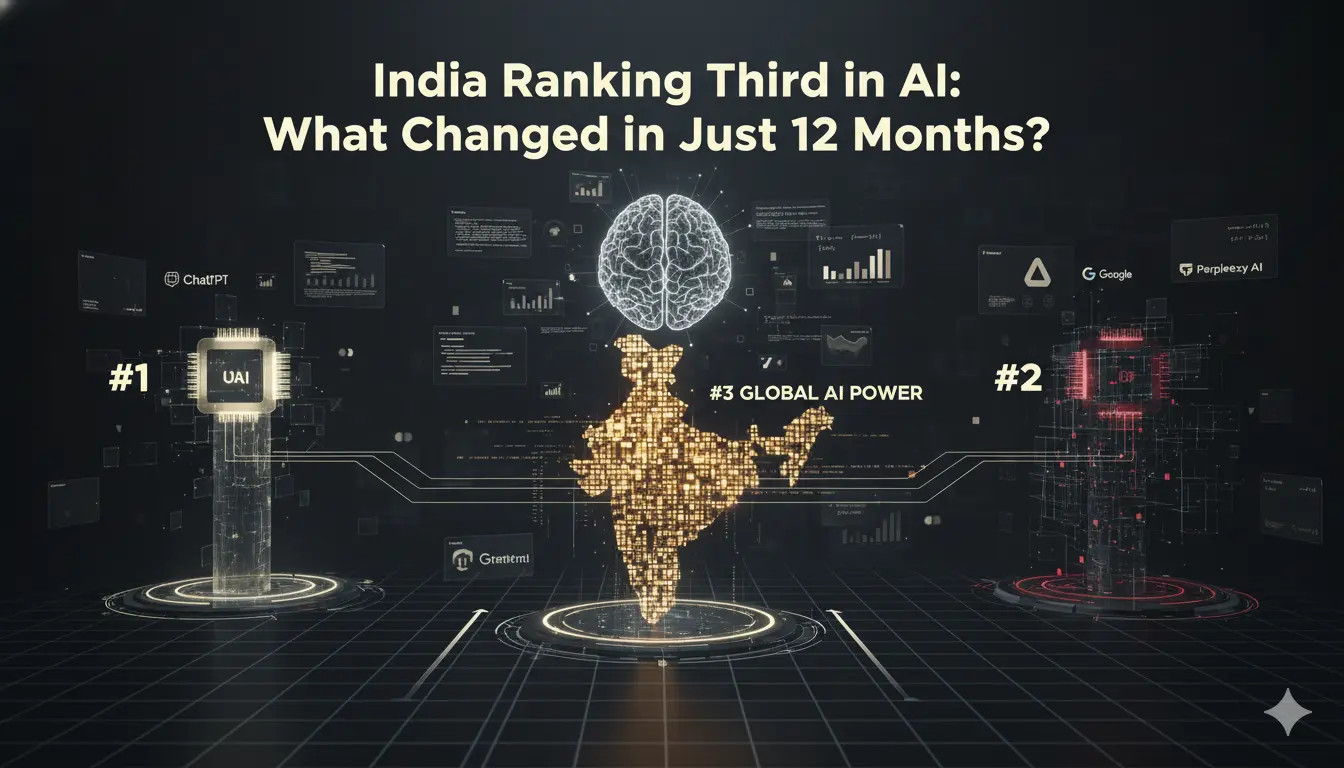
India ranking third in AI: India’s growth in artificial intelligence is no longer speculative—it is a reality grounded in data. In just 12 months, India secured the third position globally in AI competitiveness, trailing only the United States and China. This ranking showcases genuine strength in areas such as talent, research, startups, and policy implementation, indicating a fundamental transformation in India’s technological and economic environment.
This momentum is reinforced by the Stanford University Institute for Human-Centered Artificial Intelligence Global AI Vibrancy Index 2025, which positions India third globally, ahead of various established innovation centers—while also highlighting challenges related to infrastructure, computing access, and governance that will influence the decade to come.
What Is the Global AI Vibrancy Index?
The Global AI Vibrancy Index, released by the Stanford University Institute for Human-Centered Artificial Intelligence, assesses the competitiveness and dynamism of a nation’s AI ecosystem. It adopts a multi-dimensional framework that incorporates AI research, talent, startups and investment, government policy, and vital infrastructure such as computing and cloud services.
In the 2025 index, 36 countries are assessed across seven pillars. According to the most recent rankings, the United States is in the lead, China follows in second place, and India occupies the third position globally with a score of 21.59, surpassing numerous advanced economies—making it the sole lower-middle-income nation in the global AI elite.
Table of Contents
India’s Meteoric Rise to 3rd Place in Global AI Rankings
India’s rise from 7th to 3rd position in the Global AI Vibrancy Index signifies a swift advancement in startups, talent, and enterprise AI integration. The Stanford University Institute for Human-Centered Artificial Intelligence highlights that India’s large and skilled technology workforce is a key element, allowing it to outpace traditional AI hubs such as the UK and South Korea.
However, the rankings indicate a clear hierarchy. The United States remains significantly ahead, fueled by investment, cutting-edge models, and computing infrastructure, while China shines in applied AI and large-scale industrial applications. With a score of 21.59, India leads the following group, distinguished by its talent pool and cost-effective innovation, despite still falling short in physical infrastructure and access to high-end computing resources.
Factors Behind Why India Ranks Third in AI
India’s progress in the global AI rankings is driven by a strong combination of policy support, a large talent base, startups, and enterprise involvement. Initiatives such as the IndiaAI Mission and Digital India have boosted funding, research, and collaboration among public and private organizations.
A significant talent pool equipped for AI and a fast-growing startup ecosystem promote cost-effective innovation and swift scaling. Simultaneously, the broad adoption of AI in sectors like banking, logistics, agritech, and customer support empowers India to convert human capital into tangible applications—reinforcing its current standing as the third-ranked nation globally.
Why India’s AI Ecosystem Is Growing Rapidly
India ranking third in AI: The growth of AI in India is fueled more by tackling significant real-world problems at scale than by developing the largest models. The high prevalence of smartphones, UPI-driven digital transactions, and substantial datasets enable swift AI deployment in areas like banking, healthcare, agriculture, logistics, and customer support. For enterprises, this results in quicker returns on AI investments. For professionals, it indicates a growing demand for applied AI skills rather than roles centered on academic research.
This trend is highlighted in the 2025 Global AI Vibrancy Index by Stanford University’s Institute for Human-Centered Artificial Intelligence, which places India in third place for AI competitiveness.
India vs US vs China: How They Compare
India ranking third in AI; it still lags behind the United States and China in absolute scale. The US is taking the lead, supported by major private investments, advanced computing infrastructures, and the development of top-tier AI models.
China ranks second, aided by strong governmental support, a high number of patents, and widespread industrial adoption of AI. India is recognized as one of the leading countries for AI talent, thanks to its vast pool of engineers, a swiftly expanding startup ecosystem, and cost-effective innovation. However, it still falls short compared to the US and China regarding total research and development funding and advanced infrastructure.
What This Means for Students, Professionals, and Investors
India ranking third in AI The international environment offers clear opportunities for different communities. Students should anticipate finding sustainable career paths in AI, data, and cloud-related industries. Those who are already in the workforce can upgrade their skills to transition into applied AI and related roles without the need to relocate overseas. In India, entrepreneurs have access to a more robust platform for creating AI products that are relevant on a global scale, while investors can gain insights into AI advancements via Indian startups and publicly traded technology companies.
Challenges and Opportunities Ahead
India ranking third in AI: The emergence of India highlights challenging hurdles. Despite its impressive standing, the nation continues to lag behind the US and China in areas such as high-performance AI computing, groundbreaking research, and overall research and development investment. Dependence on global cloud service providers, unclear policy frameworks, and inconsistent access to AI infrastructure are critical issues that need to be addressed. The 2025 Global AI Vibrancy Index from the Stanford University Institute for Human-Centered Artificial Intelligence reveals that India’s score of 21.59 indicates strong progress—but it also underscores that closing the gap with the top two countries will require enhanced investment, stricter regulations, and broader, more inclusive AI adoption. India’s growth path also presents considerable challenges.
FAQs: Why India Ranking Third in Global AI Competitiveness
Q1. What is the Global AI Vibrancy Index?
The Global AI Vibrancy Index, presented by the Stanford University Institute for Human-Centered Artificial Intelligence, ranks countries based on the strength of their AI ecosystems, which include talent, research, startups, policy, and infrastructure.
Q2. Why does India rank third in AI?
India holds the third position owing to its extensive AI talent pool, robust startup ecosystem, increasing enterprise adoption, and favorable digital infrastructure.
Q3. Which countries are ahead of India in AI rankings?
The United States ranks first and China ranks second in global AI competitiveness.
Q4. How does India’s AI growth impact jobs?
There is a notable increase in the demand for skills related to AI, data, cloud, and automation, with a specific focus on enterprise and applied AI job functions.
Q5. Is India stronger in AI research or application?
India is currently stronger in applied AI and scalable deployment rather than frontier model research.
Final Thoughts
India ranking third in AI: India’s rise to the third position in the global AI competitiveness ranking marks a significant milestone. It validates that technology talent, startups, and research originating from India are gaining international recognition. Nevertheless, India needs to sustain this progress by increasing investments in research and development, education, and infrastructure. For readers, the key message is to remain informed and potentially gear up for growth in AI: this could involve acquiring new AI skills, exploring investments in AI-focused companies, or innovating within your sector. Be sure to bookmark this guide and check back as India’s AI landscape progresses.